According to MONGABAY
Beneath Our Feet: The Living Tapestry We Never See
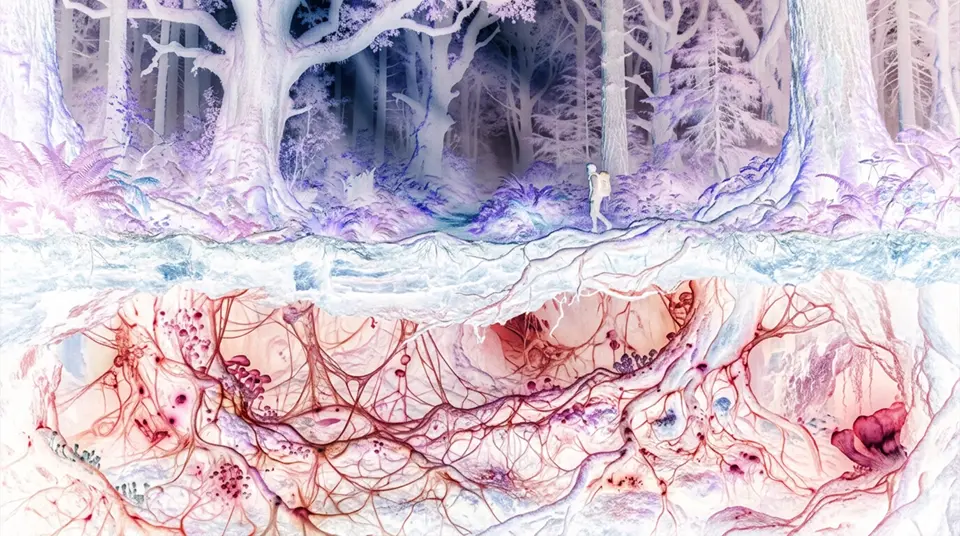
Every step we take, whether through a city park or a rainforest trail, presses against one of the most vital ecosystems on Earth—yet one we’ve scarcely understood. Mycorrhizal fungi, the delicate threads beneath the soil surface, form an ancient, underground network that connects plants, regulates climate, and stores carbon.
Now, for the first time, scientists have charted these life-sustaining webs on a global scale—and what they found is both breathtaking and alarming.
Published in Nature and spearheaded by the Society for the Protection of Underground Networks (SPUN), the study reveals vast fungal biodiversity hotspots that are largely unprotected, despite their foundational role in Earth’s ecological and climate systems.
This is the fungal equivalent of mapping rainforests or coral reefs for the first time. Only this time, the forest is invisible.
Mapping the Invisible: 25,000 Soil Samples, 2.8 Billion DNA Sequences
The study represents a monumental data effort. Scientists analyzed 2.8 billion DNA sequences from nearly 25,000 soil samples across 130 countries to create what they call the Underground Atlas—the first high-resolution global maps of mycorrhizal fungal biodiversity.
Using machine learning, they identified regions of high fungal richness and endemism, particularly in ecosystems like:
- Ethiopia’s Simien Mountains
- Brazil’s Cerrado savanna
- West African rainforests
- Tasmania’s cool forests
Yet, less than 10% of these hotspots fall within legally protected areas. That statistic has raised red flags across the conservation community.

Source: Wikimedia Commons (CC BY-SA 4.0)
Why Mycorrhizal Fungi Matter So Much
Mycorrhizal fungi form mutualistic relationships with over 80% of plant species, wrapping around or penetrating plant roots and exchanging nutrients for sugars. Their filaments—called hyphae—extend far beyond root zones, linking plants into vast “communication and trade” networks.
Some of their key roles include:
- Transporting nutrients like phosphorus and nitrogen
- Distributing water in times of drought
- Sharing resources and warning signals between trees
- Storing carbon in stable underground forms
Plants send an estimated 13 billion metric tons of CO₂ to these fungal partners each year—about a third of global fossil fuel emissions. That carbon is often locked in soils for centuries, making these networks vital players in climate stability.

Source: Wikimedia Commons (CC BY-SA 3.0)
Diversity in the Dark: Arbuscular vs. Ectomycorrhizal Patterns
The study distinguishes between two major types of mycorrhizal fungi:
- Arbuscular Mycorrhizal Fungi (Glomeromycota): Found in tropical and subtropical regions, including rainforests and savannas. Richest near the equator, their presence mirrors patterns in animal and plant diversity.
- Ectomycorrhizal Fungi (Basidiomycota, Ascomycota): More common in temperate and boreal regions, especially in coniferous forests. These fungi show peak richness in the northern hemisphere and southern parts of South America and Australia.
Each group supports different ecosystems, but both are equally crucial to global ecological resilience.

Created as a request @ Ukrainian bio project
Source: Wikimedia Commons (CC BY-SA 4.0)
A Protection Crisis: Conservation Stops at the Surface
While the world has long invested in protecting charismatic megafauna and sweeping landscapes, underground life has been left behind. SPUN’s findings highlight a major oversight: existing conservation strategies largely ignore fungal diversity, even though ecosystems cannot function without it.
Some examples of the disparity:
- In Asia, only 2.2% of arbuscular richness hotspots are protected.
- In Europe, the best-protected region, the number reaches just 19.6%.
- Coastal erosion is expected to wipe out fungal hotspots in Ghana within decades.
These gaps suggest conservation efforts are dangerously incomplete, potentially undermining food systems, water cycles, and carbon storage capacity.

Source: Wikimedia Commons (CC BY-SA 4.0)
The Underground Atlas: A Tool for Tomorrow
To address this invisibility, SPUN created the Underground Atlas, a public, interactive tool that allows users to view fungal diversity patterns anywhere on Earth with 1-kilometer resolution. Conservationists can now overlay these maps with existing protected areas, land use changes, or restoration plans.
“This isn’t just a map,” says Michael Van Nuland, SPUN’s lead data scientist and the paper’s co-author. “It’s a call to realign our conservation strategies with how life on Earth actually works.”

Source: Wikimedia Commons (CC BY 2.0)
Fungal Futures: Solutions Beneath the Soil
Recognizing the role of fungi in global challenges could shift how governments and organizations approach:
- Climate action: Soils rich in fungi store more carbon and resist erosion.
- Agriculture: Mycorrhizal networks reduce the need for fertilizers, boosting sustainability.
- Biodiversity conservation: These fungi support plant and insect diversity aboveground.
- Ecosystem restoration: Restoring fungal networks accelerates reforestation and water retention.
Rebecca Shaw, WWF’s chief scientist, emphasized their value:
“Mycorrhizal fungi need to be recognized as a priority in the ‘library of solutions’ to biodiversity decline, climate change, and food insecurity.”

Source: Wikimedia Commons (CC BY-SA 4.0)
Cultural and Scientific Blindness: Why We Missed This
Part of the problem lies in what Toby Kiers, SPUN’s executive director, calls “fungus blindness.” While forests and rivers inspire awe, fungi are seen as rot, disease, or just dirt. But that misperception has cost us dearly.
“Disrupt these ecosystems,” Kiers warns, “and forest regeneration slows, crops fail, and biodiversity begins to unravel.”
From colonial forestry to industrial agriculture, land-use decisions have long prioritized visible, profitable outputs—ignoring the fungal scaffolding that sustains them.

Source: Wikimedia Commons (CC BY-SA 3.0)
What We Can Do Now
The solutions aren’t high-tech—they’re strategic:
- Integrate fungal data into conservation planning
- Fund more fungal biodiversity research
- Include soil biodiversity in international agreements like the Convention on Biological Diversity
- Involve Indigenous and local communities, who often understand underground dynamics through traditional knowledge
SPUN is expanding its soil-sampling network and working with policymakers to turn data into action. The goal is to mainstream fungal conservation within the broader environmental movement.
From Hidden to Heroic: A New Conservation Story
This isn’t just a scientific discovery—it’s a narrative pivot. Fungi are no longer just background organisms in the grand ecological theater. They are lead actors.
Merlin Sheldrake, study co-author and SPUN’s director of impact, put it simply:
“These maps help alleviate our fungus blindness. They’re a lens into the vast, connected world beneath our feet—a world that holds the solutions we’re desperately seeking.”
Fungus as Foundation
It took four years, 25,000 soil samples, and billions of DNA sequences to make something clear: the most important ecosystem engineers are the ones we can’t see. Mycorrhizal fungi don’t just live underground—they uphold everything above it.
Protecting them is no longer optional. It’s foundational.
As the climate shifts and biodiversity dwindles, the path to resilience may be not in the skies above—but in the soil beneath.
References
- Society for the Protection of Underground Networks (SPUN): spun.earth
- Convention on Biological Diversity (CBD): cbd.int
According to MONGABAY