According to housebeautiful
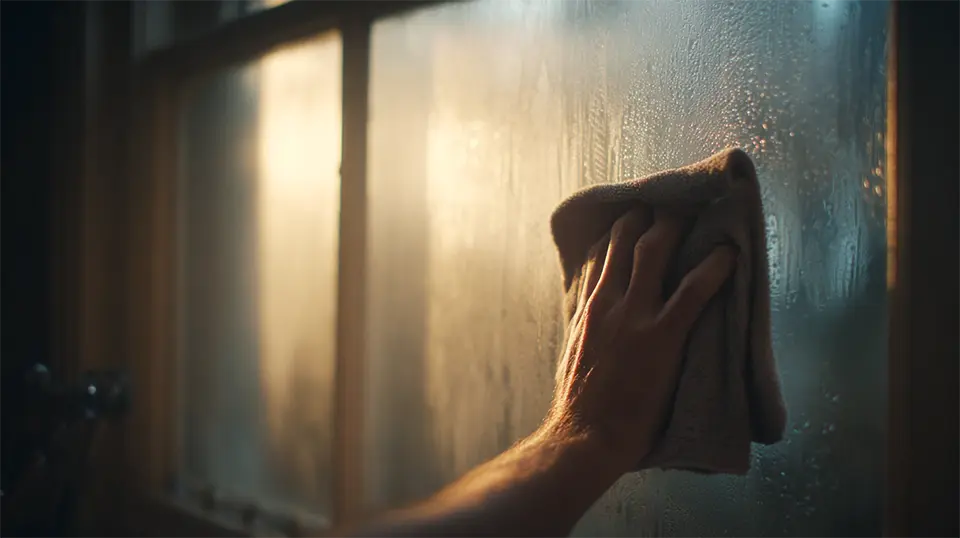
There is a specific, melancholy beauty to a winter morning. You wake up, pull back the heavy curtains, and expect to see the crisp, frosted world outside. Instead, you are greeted by a wall of tears. Your windows are crying. Beaded rivulets of water stream down the glass, pooling on the sill, soaking into the wood, and creating the perfect, damp nursery for the unwanted roommate that never pays rent: Mold.

Source: Wikimedia Commons, CC BY-SA 4.0
For millions of households, the battle against condensation is a daily ritual. It involves squeegees, old towels, and a constant, low-level anxiety about the black spots forming in the corners of the room. In the midst of a global cost-of-living crisis, where running an electric dehumidifier feels like burning money, people are desperate for a low-tech hero.
According to a recent report by House Beautiful, that hero might be hiding in your kitchen cupboard, sitting right next to the pepper. The humble grain of salt.

Source: Wikimedia Commons, CC BY-SA 4.0
As an independent observer of the microscopic wars waged in our homes, I find this trend fascinating. It represents a collision between ancient chemistry and modern desperation. But does it work? Is it safe? And most importantly, is it enough to stop the biological tide of fungi waiting to consume your window frames?
The Fact Pattern: The Viral “Hack”
The premise, as reported, is disarmingly simple. To stop water from gathering on your windows, you place a small bowl of salt on the windowsill. That’s it. No batteries, no plugs, no noise.
The logic is that salt is a natural dehumidifier. It sits there, silent and white, absorbing the excess moisture from the air before it has a chance to turn into liquid water on the cold glass. House Beautiful cites experts who claim this “budget-friendly hack” is growing in popularity across the UK and beyond, specifically because it costs pennies (or cents) to deploy.
But in the world of science, “simple” often masks “complex.” To understand if this is a solution or a placebo, we must look at the molecular level.
The Antagonist: The Dew Point
Before we analyze the cure, we must understand the disease. Why do windows cry?
It is a matter of thermal physics. The air inside your home is warm and carries moisture—from your breath, your cooking, your shower, and even your houseplants. Warm air is like a large sponge; it can hold a lot of water vapour.
Your window, however, is the “cold bridge.” It is the thinnest barrier between the cozy indoors and the freezing outdoors. When that warm, wet air hits the cold glass, it rapidly cools. Cold air is like a tiny sponge; it cannot hold as much water. The excess moisture has to go somewhere, so it drops out of the air and turns into liquid water. This is the Dew Point.
This water is not just harmless H₂O. It is the lifeblood of mold. It provides the one thing fungal spores need to activate: water activity ($a_w$). Without this condensation, the spores of Cladosporium and Alternaria that are floating in your room remain dormant. With it, they bloom.
The Protagonist: Sodium Chloride’s Thirst
Enter the salt.
Salt, or Sodium Chloride ($NaCl$), is hygroscopic. This is a fancy way of saying it is water-attractive.
At a molecular level, salt ions are electrically charged. Sodium is positive ($Na^+$); Chloride is negative ($Cl^-$). Water molecules are polar—they have a positive end and a negative end. They are magnetically drawn to the salt ions.
When you leave a bowl of salt exposed to the air, it pulls water vapor toward it. If the humidity is high enough (specifically, above about 75% relative humidity is where salt becomes truly voracious), the salt will absorb so much water that it eventually dissolves itself in the very water it attracted. This process is called deliquescence.
The theory is sound. If the salt pulls the water out of the air right next to the window, the air becomes drier. If the air is drier, the Dew Point drops. If the Dew Point drops, the condensation stops.

Source: Wikimedia Commons, CC BY-SA 3.0
The Reality Check: Physics vs. Volume
However, we must temper this optimism with the “Truth is more important than opinion” principle.
While the chemistry works, the physics of scale is the problem.
A family of four can produce up to 10 to 15 liters of water vapor a day just by breathing, cooking, and washing, according to building and indoor air experts such as the American Society of Heating, Refrigerating and Air-Conditioning Engineers and national building codes that warn about indoor moisture loads.
A small bowl of salt might be able to absorb a few milliliters of water over the course of a night.
Imagine trying to bail out a sinking rowboat with a teaspoon. You are removing water, technically. But is it enough to stop the boat from sinking?
The House Beautiful report, to its credit, notes that this is effective for minor condensation or in small spaces. It is not a magic forcefield. If you have a single-pane window in a small bathroom, a bowl of salt might make a visible difference. If you are trying to dehumidify a large living room with floor-to-ceiling glass, the salt is going to be overwhelmed.
We must also consider the saturation point. Once the salt is wet, it stops working effectively until you dry it out or replace it. It requires maintenance. It is not a “set and forget” system.
The Human Core: The Psychology of the “Hack”
Why has this story gone viral? Why are people so eager to put condiments on their windowsills?
It speaks to a deeper human need: Agency.
Mold and dampness feel like an invasion. They feel uncontrollable. They smell like decay and failure. When you see black spots appearing on your pristine white frames, it feels like the house is rotting around you.
Mechanical dehumidifiers are expensive to buy and expensive to run. In a time when electricity bills are soaring, the “hum” of a dehumidifier sounds like coins rattling out of a purse.
A bowl of salt represents control. It is cheap. It is accessible. It allows a person to feel like they are doing something to protect their home. Even if the effect is marginal, the psychological benefit of taking action is real. It is a ritual of care.
Salt is toxic to pets.
To a dog or a cat, a bowl of granular substance on a low windowsill is an object of curiosity. If a dog ingests a significant amount of salt, it can lead to hypernatremia (salt poisoning).
The symptoms are severe:
Vomiting
Diarrhea
Seizures
Lethargy
Brain swelling
Death
If you have curious pets or small children, placing open bowls of chemicals (even natural ones like salt) at an accessible height is dangerous. Veterinary toxicology references, including the MSD Veterinary Manual, document cases of fatal salt toxicosis in dogs from ingesting seemingly mundane salty items.
The report mentions using jars, but a cat can easily knock a jar over.
Furthermore, there is the mess. As the salt absorbs water, it becomes a slushy, salty brine. If this spills onto your wooden windowsill or your carpet, it is highly corrosive. Salt destroys wood finishes and rusts metal fasteners. You might save the window from mold, only to ruin the sill with salt rot.
The Nuanced Solution: What Actually Works?
If we accept that salt is a minor aid rather than a cure, what is the “Gold Standard” for those who cannot afford expensive machines?
The Morning Wipe: It is low-tech, but physically removing the water with a towel or squeegee every morning is the most effective way to prevent mold. You are manually doing what the salt is trying to do chemically.
Ventilation (The Burp): Opening the window for just 5-10 minutes a day (“burping the room”) exchanges the wet, stale indoor air with drier outdoor air, as many housing and public health guides on condensation and dampness emphasize. Even if it is cold outside, the dry air warms up faster than wet air.
Silica Gel: A safer alternative to salt. Those little packets you get in shoe boxes? They are designed for this. You can buy bulk silica gel beads which are less messy and can be “recharged” in the oven.

Source: Wikimedia Commons, CC BY-SA 4.0
The Biological Aftermath: If You Fail
Why does this matter? Why are we writing thousands of words about condensation?
Because of what comes next.
If the salt fails, and the towel is forgotten, the fungal spores germinate. The most common primary colonizers on windowsills are:
Cladosporium sphaerospermum: The classic “black mold” found on window seals. It loves thermal bridges.
Aureobasidium pullulans: Often found on the caulk and putty of windows, appearing pink or black.
Alternaria alternata: Loves dust and moisture combined.
These are not just unsightly. They release allergens. For a child with asthma, a moldy window is a respiratory trigger. Reviews of damp homes and health consistently link indoor dampness and mold to increased respiratory symptoms and asthma exacerbations in sensitive individuals.
The salt bowl is not just about clear glass; it is a desperate attempt to keep the air breathable.

Source: Wikimedia Commons, CC BY-SA 4.0
Conclusion: A Grain of Salt
The House Beautiful story is a perfect example of modern “survival” journalism. It takes a complex building science issue and reduces it to a kitchen table solution.
Does it work? Yes, marginally.
Is it a miracle? No.
Is it risky? Yes, for pet owners.
But there is something poetic about it. In the face of a cold, wet winter, we arm ourselves with the most basic element of the earth. We build little crystal fortifications against the damp.
My advice? Try the salt if you live alone and on a budget. But do not expect it to replace the laws of thermodynamics. And if you have a dog, keep the salt in the shaker and reach for the squeegee instead.
The best defense against the dark damp of winter is not a mineral, but a habit: vigilance, airflow, and the morning light.
References
- Yahoo Style UK / House Beautiful. The salt trick that helps stop window condensation overnight.
- Houzz / ASHRAE. How to Keep Water Vapor From Ruining Your House and Your Health. Citing data from the American Society of Heating, Refrigerating and Air-Conditioning Engineers on daily household moisture production.
According to housebeautiful
By the time you see it, it’s already late.
Act before it grows