According to SFGATE
San Juan Island, WA – In the quiet forests and moss-laced trails of the Pacific Northwest, where bat colonies flit through dusky skies, an invisible threat is taking hold. Wildlife officials in Oregon and Washington have confirmed the spread of a lethal fungus responsible for the death of millions of bats across North America — marking a grim milestone in the battle to preserve fragile native ecosystems.
The U.S. Geological Survey (USGS) announced on Friday that Pseudogymnoascus destructans, the cold-loving fungus that causes white-nose syndrome (WNS), was recently detected on bats at San Juan Island National Historical Park in Washington and in bat droppings (guano) at Lewis and Clark National Historical Park in Oregon. This detection marks the first-ever confirmation of the fungus in Oregon, raising urgent alarms among conservationists, researchers, and federal wildlife agencies.
Although the disease poses no threat to humans, its reach into two key national parks signals a disturbing expansion of one of the most devastating wildlife diseases ever recorded in North America.
The Disease Behind the Decline
White-nose syndrome is a disease caused by the psychrophilic (cold-loving) fungus Pseudogymnoascus destructans, which thrives in the dark, humid conditions of caves and roosting sites. It invades the exposed skin of hibernating bats, particularly the wings, ears, and muzzle, manifesting as a distinctive white fungal growth.
But the visible signs are only the beginning. The real danger lies beneath the surface.
WNS causes frequent arousals from hibernation, which severely depletes the energy reserves bats need to survive winter. These premature awakenings, paired with disrupted immune responses and tissue damage, often lead to starvation, dehydration, and death. Mortality rates among affected bat colonies can reach 90 to 100 percent in a single hibernaculum.

Source: Wikimedia Commons, Public Domain
The Arrival in the Pacific Northwest
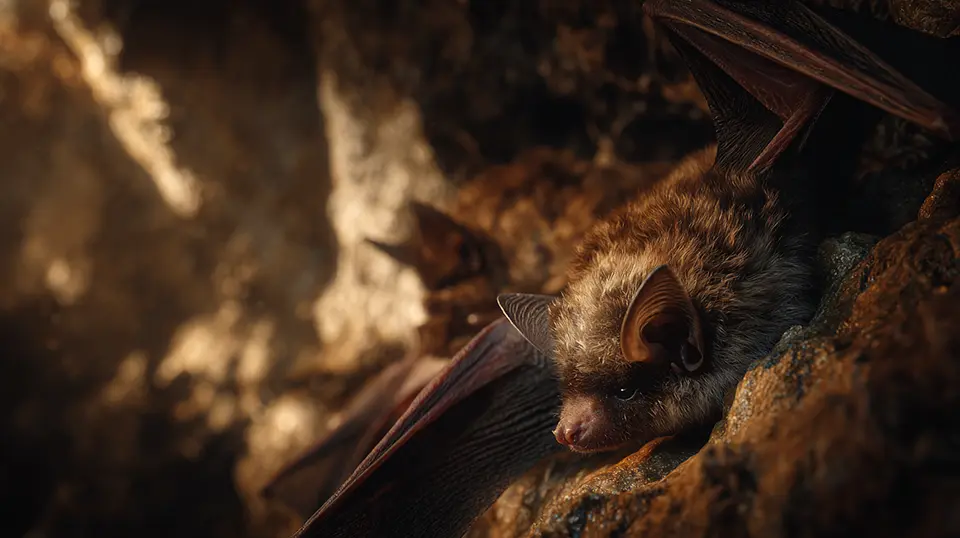
The latest confirmed detection involves a colony of Yuma Myotis bats (Myotis yumanensis), which had been roosting in a man-made bat box located at English Camp within San Juan Island National Historical Park. These bats were found carrying the fungus on their skin, although no reports of symptomatic illness have yet been made public.
In Oregon, while no infected bats were found directly, researchers detected the fungal DNA in guano samples collected from within Lewis and Clark National Historical Park. This method of detection — indirect but reliable — indicates the likely presence of colonized individuals within the area.
“This is a pivotal moment for bat conservation in the Northwest,” a spokesperson from USGS said in a statement. “Detection of Pseudogymnoascus destructans in these iconic parks signifies a wider geographical spread than we previously recorded. Monitoring, containment, and public education will be critical moving forward.”
A Contagion That Spreads Quietly
The primary transmission route for WNS is bat-to-bat contact during hibernation. However, humans can also inadvertently carry spores between roosting sites on contaminated gear or clothing, making caving, climbing, and spelunking potential contributors to the spread if decontamination protocols aren’t followed.
The disease is seasonal and spreads most aggressively during winter hibernation. Once established in a region, eradication of the fungus is virtually impossible due to its persistence in cave environments and its ability to survive without a host for extended periods.
To mitigate risk, national parks and wildlife agencies now require visitors to decontaminate footwear and equipment before entering bat habitats — a policy that has become increasingly important with the spread into Oregon.
The Larger Ecological Cost
While bats may not receive the same level of attention as polar bears or tigers in conservation campaigns, they play a critical role in controlling insect populations, pollinating plants, and dispersing seeds. A single bat can eat thousands of insects in a night — a natural pest control service that is both economically and ecologically invaluable.
The collapse of bat populations due to WNS has the potential to disrupt entire ecosystems, especially in regions where certain bat species are keystone species.
The economic impact is equally concerning. According to a 2011 study published in Science, bats provide pest control services valued at up to $3.7 billion annually in the U.S. agricultural sector. As WNS continues its deadly march westward, these benefits are increasingly at risk.
A History of Devastation
WNS was first identified in a cave in New York State in 2006 and confirmed in 2007. Since then, it has spread to over 41 states and several Canadian provinces, decimating populations of hibernating bat species, including the little brown bat (Myotis lucifugus), the northern long-eared bat (Myotis septentrionalis), and the tricolored bat (Perimyotis subflavus).
In 2023, the fungus reached California for the first time, detected in Humboldt County. Its arrival in Oregon and Washington in 2025 represents the most recent phase of westward expansion — and underscores how even remote or protected habitats are not immune.
Conservationists fear that, without effective intervention, entire species could face extinction in the coming decades. The northern long-eared bat was officially listed as endangered by the U.S. Fish and Wildlife Service in 2022 due largely to the effects of WNS.
What Can Be Done?
Although there is currently no known cure or vaccine for white-nose syndrome, researchers across the U.S. are exploring multiple avenues:
- Biological control agents that suppress fungal growth on bats.
- UV light treatments that can damage fungal DNA.
- Selective breeding or genetic studies to identify natural resistance within bat populations.
- Microclimate manipulation in hibernation sites to reduce conditions favorable for fungal growth.
Public education and citizen science initiatives also play a vital role. Hikers, campers, and cave enthusiasts are urged to report unusual bat behavior — such as flying during winter or appearing lethargic — and to avoid disturbing known bat roosts.

Source: Wikimedia Commons, Public Domain
The Road Ahead
The detection of Pseudogymnoascus destructans in two national parks of the Pacific Northwest underscores the persistent threat of white-nose syndrome and the challenges involved in containing it. While the presence of the fungus does not guarantee immediate population collapse, its history elsewhere in North America is sobering.
Officials from the National Park Service, U.S. Fish and Wildlife Service, and local wildlife organizations are expected to increase monitoring efforts, tighten biosecurity measures, and continue working with research institutions to track the disease’s progress.
In the meantime, the public is urged to stay informed, respect bat habitats, and report suspected sightings or behaviors that might indicate illness.
For many species already fighting for survival in a changing climate, WNS could be the final blow. But with increased awareness, scientific dedication, and proactive conservation, there is still hope that some bat populations may persist — and even recover — in the face of this deadly fungal invasion.
References
- White-Nose Syndrome – USGS
- White-Nose Syndrome – USFWS
- Science Journal – Economic Value of Bats in Agriculture
- Northern Long-Eared Bat – U.S. Fish & Wildlife Service
- Pseudogymnoascus destructans – Wikipedia
- Little Brown Bat – Wikipedia
- Tricolored Bat – Wikipedia
According to SFGATE