According to THE SCIENTIST
Coffee is one of the world’s most widely traded agricultural commodities and supports the livelihoods of millions of farmers across tropical regions. Yet coffee cultivation has long been threatened by fungal diseases capable of devastating plantations and disrupting global supply chains. In a recent scientific investigation, researchers revived a historic fungal pathogen that once caused severe damage to coffee crops in order to examine how its genome evolved over time. By studying the organism’s DNA, scientists hope to understand how fungal pathogens adapt and how mobile genetic elements—known as transposable elements or “jumping genes”—shape their ability to infect plants.
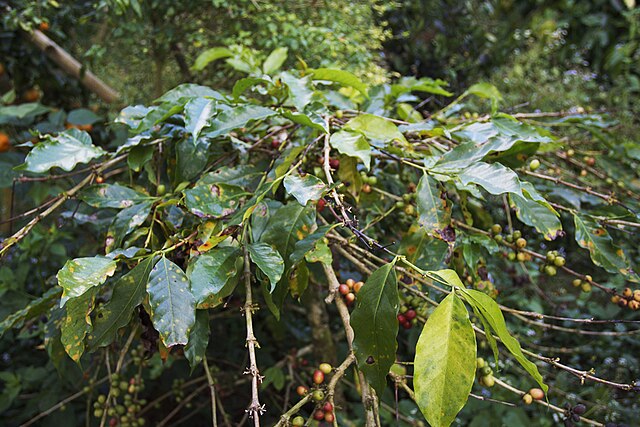
Source: Wikimedia Commons, CC BY-SA 4.0
The research focuses on coffee leaf rust, one of the most destructive diseases affecting coffee plants. Caused by the fungal pathogen Hemileia vastatrix, coffee leaf rust has historically caused dramatic declines in coffee production in many regions. The disease first gained global attention in the nineteenth century when it destroyed vast coffee plantations in parts of Asia, forcing major shifts in agricultural practices and altering the global coffee industry.

Source: Wikimedia Commons, CC BY-SA 4.0
In the recent study, scientists examined preserved samples of the fungus from historical collections. These archival specimens allowed researchers to effectively “resurrect” genetic information from the pathogen and compare it with modern strains. By sequencing and analyzing the fungal genome, the researchers sought to uncover how the pathogen has changed over time and what genetic mechanisms contribute to its ability to infect coffee plants.
Central to the investigation are transposable elements, often referred to as “jumping genes.” These DNA sequences have the ability to move within a genome, inserting themselves into new locations and sometimes altering the function of nearby genes. Transposable elements are found in many organisms, including plants, animals, and fungi, and they are known to play significant roles in genome evolution.
In fungal plant pathogens, jumping genes can influence how organisms interact with their hosts. When transposable elements insert themselves near genes involved in virulence or infection, they may alter gene expression or create genetic variation that allows the pathogen to overcome plant defenses. This process can contribute to the rapid evolution of pathogens, enabling them to adapt to resistant crop varieties or new environmental conditions.
By analyzing the genome of the coffee-infecting fungus, the researchers discovered that transposable elements occupy a substantial portion of its DNA. These elements appear to be concentrated in regions associated with genes that determine how the fungus infects host plants. Such genomic architecture may allow the pathogen to evolve quickly in response to plant immune defenses.
The researchers also compared historical samples of the fungus with contemporary strains collected from modern coffee plantations. This comparison revealed patterns of genetic change that help explain how the pathogen has persisted and adapted over time. Some genetic regions showed high variability, suggesting that the pathogen continually modifies certain genes in response to host resistance.
Understanding these mechanisms is important for agriculture because plant breeders frequently develop new crop varieties that are resistant to specific diseases. However, pathogens can sometimes evolve rapidly and overcome these defenses. The movement of transposable elements within fungal genomes may accelerate this process, generating new variants capable of infecting previously resistant plants.
The study of historical fungal pathogens offers a valuable window into the evolutionary processes shaping plant diseases. Archived specimens preserved in herbaria and scientific collections provide snapshots of past pathogen populations. By extracting DNA from these specimens, researchers can reconstruct the evolutionary history of diseases and trace how pathogens spread and adapt.
For coffee farmers and agricultural scientists, insights from this research may contribute to improved disease management strategies. By understanding which genomic regions are prone to rapid change, researchers may be able to identify vulnerabilities in the pathogen or develop more durable forms of plant resistance.
Coffee leaf rust continues to pose a major threat to coffee production worldwide. In recent decades, outbreaks in Latin America and other regions have caused significant economic losses and disrupted farming communities. Climate change, shifting weather patterns, and global trade can further influence how fungal pathogens spread and evolve.

Source: Wikimedia Commons, CC BY-SA 4.0
The new research highlights how advanced genomic sequencing technologies are transforming the study of plant diseases. Modern DNA sequencing allows scientists to analyze fungal genomes in unprecedented detail, revealing the complex interactions between pathogens and their host plants. Combined with historical samples, these technologies provide a powerful tool for understanding the long-term evolution of crop diseases.
Beyond coffee agriculture, the findings also contribute to broader knowledge of fungal genomics. Transposable elements are a major component of many fungal genomes, and their movement can influence traits ranging from pathogenicity to environmental adaptation. Studying these elements in economically important pathogens helps researchers understand how fungal species diversify and persist.
The work also underscores the importance of preserving biological collections. Historical specimens stored in research institutions may contain genetic information that becomes increasingly valuable as sequencing technologies advance. By revisiting these collections, scientists can reconstruct past epidemics, track evolutionary change, and gain insights into future disease risks.
Ultimately, the revived fungal samples reveal how dynamic fungal genomes can be. The movement of jumping genes within the pathogen’s DNA appears to contribute to its ability to adapt, survive, and infect new plant hosts. For global agriculture, understanding these processes is essential for protecting crops that millions of people depend on for income and food security.
References
Encyclopedia Britannica – Coffee rust fungus
According to THE SCIENTIST