According to THE CHARLOTTE OBSERVER
A Hidden Network Beneath the Surface
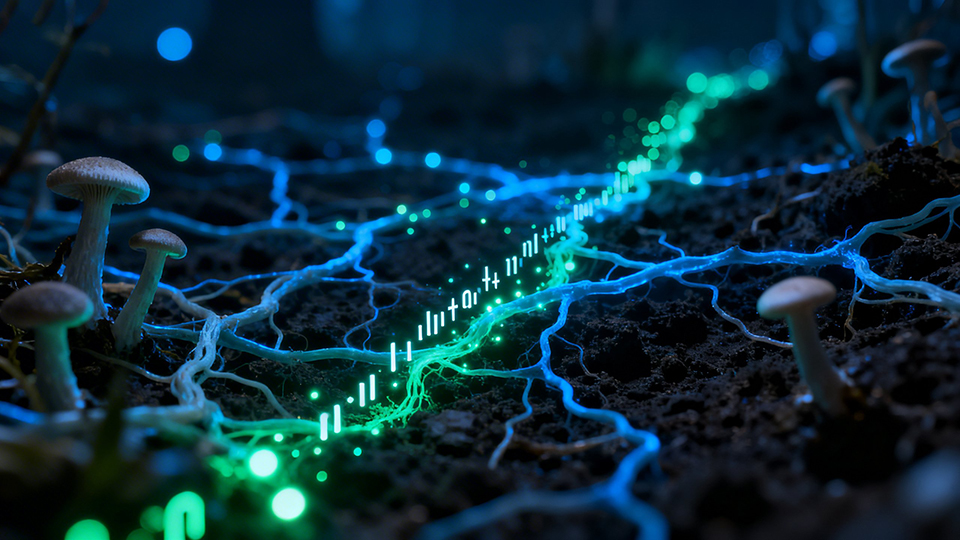
Beneath soil, forests, and decaying organic matter lies an intricate network of fungal structures known as mycelium. These thread-like systems, composed of microscopic filaments called hyphae, are increasingly recognized not only for their ecological role but also for their potential to transmit information. Recent research has drawn attention to an unexpected phenomenon: fungi may generate electrical patterns that resemble structured communication, raising questions about whether these organisms process information in ways comparable to language.
The findings contribute to a growing field of study investigating how non-neural life forms coordinate behavior and respond to environmental stimuli.

Measuring Electrical Activity in Fungi
The research was led by Professor Andrew Adamatzky, who conducted experiments using microelectrodes inserted into substrates colonized by fungal mycelium. By recording electrical activity across these networks, the study analyzed patterns produced by multiple fungal species, including enoki, split gill, ghost fungus, and caterpillar fungus.
The recorded data revealed that fungi produce sequences of electrical spikes—referred to as “spike trains”—which vary in length and frequency. These patterns were not random; instead, they formed clusters that appeared to follow structured distributions. In some cases, these groupings resembled a vocabulary-like system containing up to 50 distinct patterns.
This observation prompted comparisons to human language, particularly in terms of pattern diversity and organization.

Electrical Spikes and Information Processing
Electrical signaling in fungi is not entirely new to science. Previous studies have shown that hyphae can conduct electrical impulses in ways analogous to neural signaling in animals (Royal Society Open Science). These impulses may increase in activity when fungi interact with external stimuli, such as contact with wood or other nutrient sources.
The study suggests that these electrical signals could serve as a mechanism for internal coordination within the fungal network. For example, signals may help regulate growth, direct nutrient transport, or respond to environmental changes.
However, the interpretation of these signals remains uncertain. While the patterns show structural similarities to language, researchers caution against assuming that fungi “communicate” in a human-like sense.
The Question of “Fungal Language”
One of the most striking aspects of the research is the suggestion that fungal electrical activity may resemble a form of vocabulary. The spike patterns identified in the study exhibited statistical distributions similar to those found in human language systems.
Despite this resemblance, the lead researcher emphasizes caution. The similarities may reflect general principles of information processing rather than evidence of true language. In biological systems, pattern formation can arise from physical and chemical processes without implying conscious communication.
An alternative explanation is that the electrical spikes are simply a byproduct of growth processes. As hyphal tips extend and interact with their environment, changes in electrical potential may occur naturally, producing measurable signals without carrying specific meaning.
What the Signals Might Represent
Although definitive conclusions have not been reached, researchers propose several possible functions for fungal electrical signaling. One hypothesis is that the signals help coordinate resource distribution across the mycelial network. Fungi often connect multiple nutrient sources and may need to regulate how resources are allocated.
Another possibility is that the signals respond to environmental stress or damage. When parts of the network encounter obstacles or threats, electrical activity could help redirect growth or trigger adaptive responses.
There is also speculation that these signals may extend beyond the fungal network itself. In ecosystems, fungi often form symbiotic relationships with plants, potentially allowing information exchange across species boundaries (Mycorrhiza).

The “Wood Wide Web” Concept
Fungal networks are a central component of what ecologists refer to as the “Wood Wide Web,” a system of underground connections linking plant roots through mycorrhizal fungi. These networks facilitate the transfer of nutrients such as carbon and nitrogen between plants.
In addition to nutrient exchange, research suggests that chemical signaling may occur within these networks, allowing plants to respond to environmental stress or pest activity. The possibility that electrical signals also play a role adds another layer of complexity to this system.
While this does not constitute communication in the human sense, it does indicate a form of biological coordination that operates across multiple organisms.
Scientific Uncertainty and Ongoing Debate
Despite the intriguing findings, the scientific community remains cautious. A 2025 review highlights that while fungal hyphae can produce spike-like electrical activity, the functional significance of these signals is still unclear.
One challenge is the difficulty of measuring electrical activity in fungal systems. Mycelial networks are microscopic, highly dynamic, and influenced by environmental variables, making it difficult to isolate meaningful patterns from background activity.
Another issue is distinguishing between communication and metabolism. Electrical signals may simply reflect internal biochemical processes rather than intentional information transfer.
Researchers agree that more advanced tools and experimental methods are needed to clarify these questions.
Differences Between Species
The study also found that different fungal species exhibit varying levels of signaling complexity. Some species produced more diverse and structured spike patterns than others, suggesting that electrical activity may differ depending on ecological role or biological characteristics.
This variation raises further questions about how fungal networks evolve and whether certain species are more capable of complex information processing.
Understanding these differences may help researchers identify the underlying mechanisms driving electrical activity in fungi.
Implications for Understanding Intelligence
The research contributes to a broader discussion about biological intelligence and information processing. Traditionally, intelligence has been associated with nervous systems, but findings like these suggest that complex behavior may emerge in systems without neurons.
Fungal networks operate through decentralized structures, yet they are capable of adapting to environmental changes, optimizing resource distribution, and maintaining large-scale connectivity.
If electrical signaling plays a functional role in these processes, it could reshape how scientists define intelligence in living systems.
Future Directions in Research
The field of fungal signaling research is still in its early stages. Future studies are expected to focus on improving measurement techniques, expanding the range of species studied, and testing specific hypotheses about signal function.
Researchers aim to determine whether electrical patterns correspond to measurable biological outcomes, such as changes in growth direction or resource allocation. Advances in imaging, bioelectronics, and computational modeling may provide new insights.
As the field develops, it may reveal new principles of information processing that extend beyond traditional biological frameworks.
A Measured Interpretation of the Findings
While the idea of fungi “speaking” may capture public imagination, scientists emphasize that current evidence does not support the existence of language or conscious communication in fungi. The observed patterns are better understood as structured electrical activity that may or may not carry functional meaning.
The significance of the research lies not in confirming fungal language, but in expanding our understanding of how living systems process information.
A New Perspective on the Natural World
The study highlights the complexity of life beneath the surface and challenges assumptions about the limits of biological communication. Fungi, often overlooked in discussions of intelligence, may possess sophisticated systems for coordinating behavior at the network level.
Whether these systems represent a form of communication, computation, or simply emergent biological processes remains an open question.
What is clear is that fungal networks are more dynamic and responsive than previously thought, and their study may offer insights into the fundamental nature of life and information.
References
Adamatzky, A. (2022). On spiking behaviour of fungi. Royal Society Open Science.
According to THE CHARLOTTE OBSERVER