According to TECHNO SCIENCE.NET
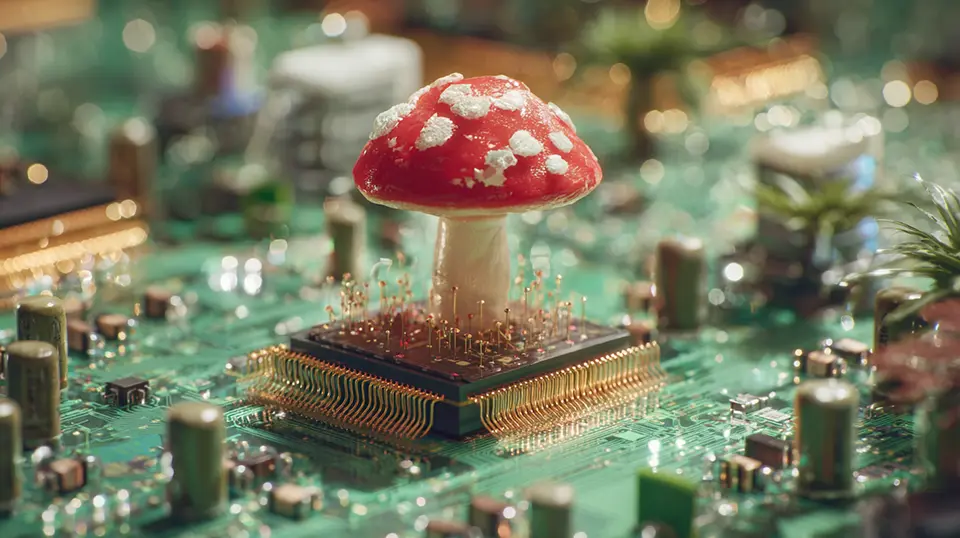
Scientists have successfully transformed mushrooms into a form of computer memory, revealing a novel intersection between biology and computing technology. The research shows that fungal structures, long studied for their ecological importance, can also perform information storage functions traditionally reserved for electronic materials.
The findings add to a growing body of work exploring biological systems as computing substrates and raise new possibilities for sustainable, adaptive, and energy-efficient information technologies.

Source: Wikimedia Commons – Mycelium rhizomorphs, CC BY-SA 4.0
From Forest Floor to Data Storage
Mushrooms are the visible fruiting bodies of fungi, but the real functional structure lies underground in vast networks of mycelium. These thread-like filaments form complex, interconnected systems capable of responding to environmental stimuli such as light, nutrients, pressure, and electrical signals.
Researchers have now demonstrated that these same properties can be harnessed to encode, store, and retrieve information. By interfacing fungal material with electronic components, they showed that mushrooms can function as memory units capable of retaining states over time.
This challenges conventional assumptions that biological materials are too unstable or imprecise for computing applications.
How Fungal Memory Works
The memory function relies on the electrical behavior of fungal mycelium. When exposed to electrical stimulation, fungal networks exhibit measurable changes in conductivity and electrical resistance. These changes can persist, effectively allowing the system to “remember” past inputs.
In practical terms, these electrical states can be interpreted as binary information, similar to the ones and zeros used in digital computing. Unlike silicon-based memory, however, fungal memory does not require rigid architectures or complex fabrication processes.
Instead, the living structure itself adapts and reorganizes, enabling information storage through biological processes rather than fixed circuitry.
Why Fungi Are Suitable for Bio-Computing
Fungi possess several traits that make them attractive candidates for unconventional computing:
- highly interconnected network structures
- natural signal transmission capabilities
- resilience to environmental stress
- ability to grow and self-repair
- low energy requirements
These characteristics allow fungal systems to process information in parallel rather than sequential ways.
Researchers emphasize that this approach does not aim to replace conventional computers, but rather to complement them in specific applications where adaptability and sustainability are priorities.
Sustainability and Material Advantages
One of the most significant implications of the research lies in sustainability. Traditional computing hardware relies on rare minerals, energy-intensive manufacturing, and generates large amounts of electronic waste.
Fungal materials, by contrast, are biodegradable, renewable, and can be grown using agricultural byproducts. Mycelium-based materials require far less energy to produce and can be composted at the end of their lifecycle.
 Samples of: mycelium composite, spruce shives, rice husks and shredded textile
Living Materials That Change Over Time
Unlike static electronic components, fungal systems are alive. This introduces both opportunities and challenges.
On the positive side, living materials can adapt to changing conditions, heal minor damage, and reorganize themselves. This could enable computing systems that respond dynamically to their environment or recover from partial failure.
However, biological variability complicates predictability and control. Researchers note that stabilizing memory states and ensuring reproducibility will be key challenges before practical deployment.
Potential Applications Beyond Computing
The implications of fungal-based memory extend beyond traditional computing. Researchers suggest potential applications in:
- biosensors that record environmental changes
- smart materials that respond to stimuli
- adaptive architecture
- low-power data storage for remote environments
In these contexts, the ability of fungi to integrate sensing, processing, and memory within a single material could offer advantages over conventional electronic systems.
Relation to Other Bio-Computing Research
This work builds on earlier studies showing that fungi can transmit electrical signals similar to neural impulses. Some researchers have likened mycelial networks to primitive information-processing systems.
It also complements research into bacterial computing, DNA-based data storage, and neuromorphic systems inspired by biological brains.
Common Fungal Species Used in the Research Context
While multiple fungi exhibit suitable properties, species commonly explored for mycelium-based electronics include:

Source: Wikimedia Commons – Pleurotus ostreatus mycelium, CC BY-SA 4.0
Conclusion
The successful transformation of mushrooms into functional computer memory highlights the untapped technological potential of fungi. By leveraging the natural electrical and structural properties of mycelium, researchers have demonstrated a new form of bio-based memory that challenges traditional computing paradigms.
While practical applications remain in early stages, the work underscores a broader shift toward integrating living systems into technology design. As computing seeks sustainable and adaptive alternatives, fungi may play an unexpected but significant role in shaping the future of information storage.
References
Ceze L. et al., 2019, Nature Reviews Genetics, DNA-based data storage
WHO – Electronic Waste Fact Sheet
According to TECHNO SCIENCE.NET