According to SYRACUSE.COM
A New Threat Emerges in the Northeast
For decades, New York’s forests have endured countless challenges — from invasive insects to climate stress — but this summer, an ominous new chapter began to unfold. A tree disease once thought to be confined to the southern United States has made its way north.
Laurel wilt, a fast-acting and often fatal fungal disease that affects trees and shrubs in the laurel family, has been confirmed for the first time in New York State, according to the Department of Environmental Conservation (DEC). The detection occurred in Northport, Long Island, when a concerned homeowner submitted a dying sassafras tree to Cornell University’s Plant Disease Diagnostic Clinic.
What came back was more than just a diagnosis — it was a warning.
What Is Laurel Wilt?
Laurel wilt is caused by the fungus Raffaelea lauricola, which is introduced into host trees by the redbay ambrosia beetle (Xyleborus glabratus), an invasive species native to Asia.
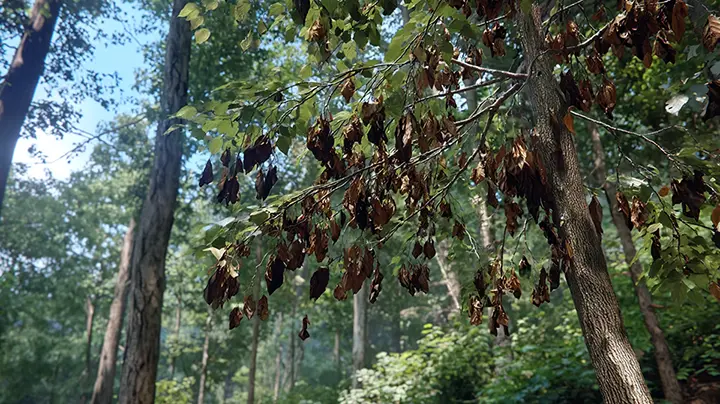
When the beetle burrows into a tree’s vascular tissue to cultivate the fungus — its food source — it leaves behind fungal spores. These spores then colonize the tree’s xylem, blocking water flow and causing the tree to wilt and die, often within weeks.

Source: Wikimedia Commons, CC BY 3.0
Timeline of the Invasion
- 2002: Laurel wilt is first identified in the U.S. in Georgia.
- 2010s: The disease spreads through much of the southeastern U.S., devastating redbay, avocado, and other laurel family members.
- 2020s: Cases reach Kentucky and Virginia, the previous northernmost limits.
- July 2025: First confirmed case in New York, signaling a troubling northern expansion.

Source: Wikimedia Commons, CC BY-SA 4.0
What Trees Are at Risk in New York?
While mountain laurel — despite its name — is not affected (it belongs to a different plant family), two native and ecologically important species in New York are vulnerable:
Both play key roles in forest ecosystems:
- Sassafras provides cover and fruit for mammals and birds and serves as a larval host for tiger swallowtail butterflies.
- Spicebush is essential for pollinators, birds, and spicebush swallowtail butterflies, whose caterpillars depend on its leaves.
- The berries of spicebush are a critical food source for migratory birds in the fall.
Their loss would trigger a chain reaction — disrupting food webs, reducing forest biodiversity, and potentially allowing invasive plants to gain a foothold.

Source: Wikimedia Commons, CC BY-SA 3.0
Symptoms to Watch For
The DEC urges the public to report potential infections. Common symptoms of laurel wilt include:
- Sudden wilting and browning of leaves
- Dark, streaky discoloration in the sapwood just beneath the bark
- Tiny entry holes in the bark, often with sawdust “toothpicks” protruding — signs of beetle boring activity
Once symptoms appear, tree death can occur rapidly — sometimes in less than a month. Unlike many other tree diseases that take years to cause decline, laurel wilt is swift and fatal.
How It Spreads
The disease spreads via the redbay ambrosia beetle, a wood-boring insect no larger than a grain of rice. A single beetle can carry enough spores to infect a tree. But the real danger comes from the amplification effect: as trees die, new beetles emerge and spread further.
Other pathways include:
- Movement of firewood
- Nursery stock
- Storm-driven winds
- Infested wood products
Once established in a region, controlling the disease becomes exceedingly difficult. This is why early detection and containment are essential.
The Ecological Cost
Though sassafras and spicebush may not dominate the canopy like oak or maple, their roles are vital:
- Spicebush is often found in moist understory zones, providing cover and food for wildlife.
- Its loss could lead to decreased pollinator abundance and fewer fall food options for birds.
- Sassafras is one of the few aromatic native trees and part of traditional medicine and folklore.
Their disappearance would not only reshape forest structure but also disrupt the microhabitats they support.
As DEC officials noted, “The decline of either of these plant species would reduce forest diversity, weaken natural food webs, and increase native forest susceptibility to invasive plants.”

Source: Wikimedia Commons, CC BY-SA 3.0
A Pattern Repeating Itself
This is not the first time New York has faced a fungal invasion:
- Dutch elm disease wiped out millions of native elms.
- Chestnut blight decimated the American chestnut.
- Beech leaf disease is now affecting forests across the Northeast.
- Oak wilt continues to spread in some parts of the state.
What sets laurel wilt apart is its speed, insect vector, and broad host range across the Lauraceae family.
And once established, there is no known cure.

Source: Wikimedia Commons, CC BY-SA 3.0
Coordinated Response Underway
In the wake of this detection, New York’s DEC and Department of Agriculture are taking swift action. According to Commissioner Amanda Lefton and Agriculture Commissioner Richard A. Ball, the state is:
- Surveying and mapping affected and at-risk areas
- Raising public awareness through press and outreach
- Advising landowners and nurseries on best practices
- Encouraging public reporting of symptoms or unusual tree deaths
- Collaborating with Cornell University and other researchers on potential containment strategies
While no fungicide or treatment currently exists for laurel wilt, knowledge is growing. Researchers are studying beetle behavior, fungal resistance, and even potential biocontrol agents that could disrupt the fungus-beetle relationship.
What You Can Do
Homeowners, hikers, landscapers, and landowners all have a role to play. Here’s how you can help:
- Don’t move firewood: This is the #1 human-assisted pathway for forest pests.
- Know the symptoms: If you see signs of wilting or sawdust toothpicks, report it.
- Avoid planting susceptible species in high-risk areas.
- Support native biodiversity: Diverse forests are more resilient to invasive threats.
- Report suspicious trees to your local DEC office or forestry authority.
Small actions, repeated across a state, can slow a disease’s spread.
Hope in Resistance?
Some researchers are exploring whether genetic resistance exists among sassafras or spicebush populations. In Florida and Georgia, a small percentage of trees have survived in infected areas — leading scientists to hope that natural resistance genes may eventually be identified and used in reforestation efforts.
However, such work takes years, and the disease is spreading now.
The Bigger Picture: Forests Under Siege
Laurel wilt is not just a New York problem — it’s part of a larger global pattern in which:
- Fungal diseases, many linked to global trade, are emerging at record rates.
- Invasive insects are introducing pathogens to which native species have no defenses.
- Climate change is accelerating disease spread by creating warmer, wetter conditions.
Forest ecosystems that evolved over millennia are now being transformed in decades, often irreversibly.
The arrival of laurel wilt in New York is not only an environmental concern — it’s an urgent call for policy, public education, and ecological vigilance.

Source: Wikimedia Commons, CC BY-SA 4.0
References
USDA Forest Service. Laurel Wilt Information.
According to SYRACUSE.COM