According to THE TIME OF INDIA
A Discovery at the Edge of Biology and Geology
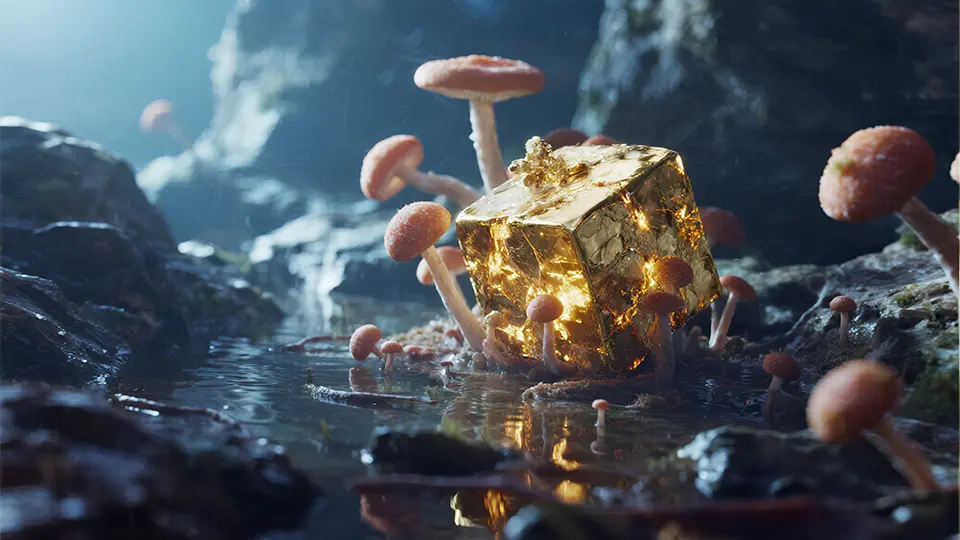
In Western Australia, a region known for its mineral-rich landscapes, scientists have identified a remarkable organism that is reshaping how researchers understand the relationship between life and metals. According to a report by The Times of India, researchers have discovered a fungus capable of interacting with gold particles—an ability that could have implications far beyond Earth.

How a Fungus “Eats” Gold
Despite the dramatic description, scientists clarify that the fungus does not consume gold in the conventional sense. Instead, it participates in a biochemical process that allows it to dissolve and precipitate gold particles from its surroundings.
Through metabolic activity, the fungus interacts with trace minerals, facilitating the transformation of gold into forms that can accumulate on its surface. Over time, microscopic gold particles attach to the fungal structure, creating a visible association between the organism and the metal.
This process highlights a broader phenomenon known as biomineralization, where living organisms influence the formation and transformation of minerals. In this case, the fungus acts as a mediator between its environment and metallic elements, altering how gold is distributed at a microscopic level.

Implications for Mining and Resource Exploration
The discovery has potential applications in mineral exploration. By identifying areas where such fungi are present, geologists may gain new tools for locating hidden gold deposits. Instead of relying solely on traditional geological surveys, biological indicators could complement existing exploration techniques.
In regions like Western Australia, where mining plays a central economic role, such innovations could improve efficiency and reduce environmental impact. The ability to detect gold through biological activity offers a less invasive alternative to large-scale excavation.

From Earth to Space: Expanding the Research Horizon
Perhaps the most intriguing aspect of the discovery is its potential application beyond Earth. Scientists are exploring the possibility of using such fungi in space missions, particularly for resource extraction in extraterrestrial environments.
In space, where transporting materials from Earth is costly and complex, the ability to utilize local resources becomes critical. If fungi like Fusarium oxysporum can function in microgravity or other extreme conditions, they could assist in extracting useful elements from asteroids or planetary surfaces.
This concept aligns with emerging strategies in space exploration that focus on in-situ resource utilization (ISRU), where materials are sourced directly from the environment rather than transported across vast distances.
The Resilience of Fungi in Extreme Conditions
Fungi are increasingly recognized for their resilience, capable of surviving in environments that would be hostile to most forms of life. From deep underground ecosystems to highly mineralized soils, they demonstrate an ability to adapt to chemical and physical extremes.
This resilience makes them attractive candidates for space-based applications. Their capacity to interact with metals, tolerate stress, and maintain metabolic activity under challenging conditions suggests they could play a role in future extraterrestrial ecosystems or industrial processes.
Scientific Caution and Future Research
While the discovery is promising, researchers emphasize that much remains to be understood. The mechanisms behind the fungus’s interaction with gold require further investigation, particularly at the molecular level. Additionally, the feasibility of applying this process in controlled or extraterrestrial environments is still under study.
There are also practical considerations. Scaling such biological processes for industrial or space applications presents technical challenges, including maintaining stable growth conditions and ensuring predictable outcomes.
A Broader Perspective on Life and Materials
Beyond its immediate applications, the discovery invites a deeper reflection on the relationship between living organisms and the inorganic world. The idea that a fungus can influence the distribution of gold challenges traditional boundaries between biology and geology.
It suggests that life does not merely adapt to its environment but actively reshapes it, even at the level of precious metals. In this sense, the fungus becomes not just a subject of study but a participant in Earth’s ongoing geological processes.

Looking Forward
As research continues, the potential uses of gold-interacting fungi may expand, from improving mining techniques to supporting future space missions. While practical implementation may still be years away, the discovery represents a step toward integrating biological systems into technological and industrial solutions.
In the quiet soils of Western Australia, a microscopic organism has opened a window into new possibilities—where biology meets mineral wealth, and where the tools for exploring distant worlds may already exist beneath our feet.
References
Gadd, G. M. (2010). Metals, minerals and microbes: geomicrobiology. Microbiology.
According to THE TIME OF INDIA