According to SCIENCE
Introduction: Underground Farmers of Antiquity
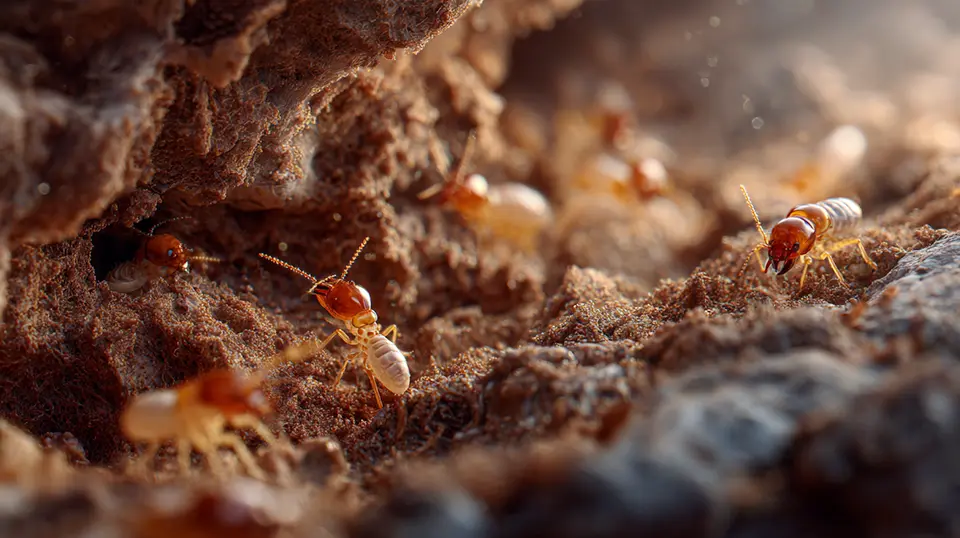
More than 50 million years ago, long before humans cultivated fields, certain termite species were already raising fungus—inside their nests, under the earth, in a silent and complex system of cultivation. These fungus-farming termites, such as Odontotermes obesus, maintain subterranean gardens of Termitomyces, a symbiotic fungus they eat. But as any farmer knows, cultivating a crop invites competition—and in this case, the competition comes from unwanted or invasive fungi, the “weeds” of termite agriculture.
A new study, published in Science, unpacks one of the termites’ strategies for weed control: rather than simply eliminating invaders by force, they bury contaminated fungal combs in soil containing antifungal microbes, effectively isolating and suppressing the parasite while preserving their cultivated fungus. This behavior is not crude—it is calibrated, selective, and remarkably efficient.

Source: Wikimedia Commons, CC BY-SA 4.0
Termite Fungiculture: How It Works
To appreciate the innovation, it helps to understand termite agriculture:
- Substrate harvest and preparation
Worker termites gather plant material—leaf litter, dead wood—and reduce it to fine fragments. - Fungal inoculation and growth
These fragments form the “comb” structure inside the termite nest. Termitomyces is then introduced, colonizing the substrate. - Harvesting and consumption
The termites feed on the fungus that grows through the comb, digesting plant matter more efficiently than they could alone. - Regeneration and propagation
Some sections are left to grow and reproduce, ensuring continued fungal supply.
Throughout this process, the termites ensure that environmental conditions (temperature, humidity, air flow) remain within narrow bounds optimal for fungal growth. In effect, termite nests function much like human greenhouses—but in miniature, subterranean form.
Given the cost and complexity of maintaining these gardens, termites have evolved multi-layered defenses against invaders—fungi that might outcompete or disrupt their fungal crop.
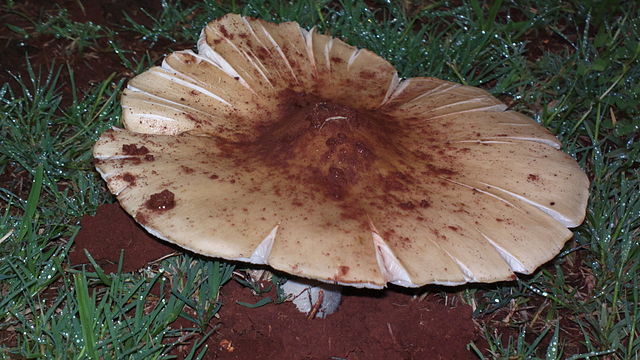
Source: Wikimedia Commons, CC BY-SA 4.0
The Threat: Pseudoxylaria and Other Invaders
Among the common threats is a genus called Pseudoxylaria. This fungus behaves like a weed, growing quickly on the same substrate the fungus crop uses. If left uncontrolled, Pseudoxylaria can invade and overwhelm Termitomyces.
In field and laboratory settings, removed termite nests often show traces of Pseudoxylaria, but active termite colonies maintain remarkably clean fungal gardens with little visible contamination. The question has long been: how do termites achieve this continuous control?
The Experiment: Burying vs. Sanitizing
Researchers from the Indian Institute of Science Education and Research, Mohali (IISER Mohali) and collaborators brought termite combs and individuals into controlled lab settings. They designed a series of tests:
- Healthy comb vs. infected comb: Termites were presented with fungal combs, some inoculated with Pseudoxylaria, others healthy. The termites selectively buried contaminated combs—but left healthy ones exposed.
- Sterile soil burial test: Comb infected with Pseudoxylaria was buried in sterilized soil. In that environment, the fungus continued growing unhindered.
- Soil microbial extract test: Extracts from soil previously used by the termites to bury Pseudoxylaria were applied to fungal cultures. The extracts inhibited growth of Pseudoxylaria in Petri dish assays.
From these experiments, the team concluded that termites rely not only on their behavioral burying but also on resident soil microbes to inhibit weed fungus growth.
Furthermore, termite behavior is graded: they respond differently depending on how severe the infection is. In mild cases, they’ll simply remove or excise the contaminated portion; in severe cases they bury entire comb pieces.
When experimental combs containing mixed Termitomyces and Pseudoxylaria were glued together, termites broke off and buried the infected portion, preserving the healthy part—a surgical precision indicating a nuanced detection mechanism.
Mechanisms and Implications
This system offers something akin to integrated pest management in miniature. The termites do not indiscriminately spray chemicals or destroy large swaths of crop. Instead:
- They scavenge or excise small threats early.
- They bury major infestations, isolating contaminated material.
- They deploy microbial allies in soil to suppress residual fungal spores.
The termite approach shows efficiency, sustainability, and minimal collateral damage to their crop fungus.
From an ecological and evolutionary viewpoint, the strategy points to a complex symbiosis among termites, their fungal crop, and the soil microbial community. The termites are farmers not only in raising Termitomyces, but also in managing microbial communities in soil for defense.

Source: Wikimedia Commons, CC BY-SA 4.0
Wider Lessons: Biocontrol and Sustainable Agriculture
The termite defense system may inspire novel biocontrol strategies in agriculture or waste management:
- Microbial suppression as a natural alternative to chemical fungicides
- Selective burial or containment of contamination in composting or waste systems
- Understanding how organisms curate microbiomes to suppress pathogens
Given increasing resistance to many synthetic fungicides, nature’s own microbial arms race provides a template for more sustainable disease control.
Challenges, Open Questions, and Future Work
- Which microbial taxa in termite burial soil inhibit Pseudoxylaria?
- How do termites detect the degree of infection and decide between excision or burial?
- Are these strategies generalized across other fungus-farming termite species?
- What is the energetic cost to termites of building and maintaining such microbial-rich burial systems?
- Can we domesticate or mimic these interactions for agricultural or environmental use?
The team continues to investigate these directions, employing genomic and metabolomic profiling of soil microbes and termite behavior tracking.
My View: Nature’s Subterranean Farmers Offer Insights
It’s humbling to realize that termite colonies thousands of years old quietly perform complex farming tasks far below ground, with strategies rivaling human agriculture in sophistication. Their capacity to integrate behavior, microbial alliances, and pest control highlights how evolution crafts intelligent systems without consciousness.
As we confront ecological challenges—pathogen resistance, sustainable agriculture, habitat degradation—such natural models offer powerful lessons. The termite method of burying infectious material in microbial armor is elegant, minimal, and effective. If humans pay attention, we might learn a thing or two about farming with nature rather than against it.

Source: Wikimedia Commons, CC BY-SA 4.0
References
- Odontotermes obesus – Wikipedia
- Termitomyces – Wikipedia
- IISER Mohali – Research Department of Biological Sciences
According to SCIENCE