According to nature india
I. Transforming Waste with Biology: The Fungal Engineering Breakthrough
Fungi can transform agricultural and paper wastes into biodegradable materials that can be engineered to mimic the properties of plastic foam used for packaging¹.
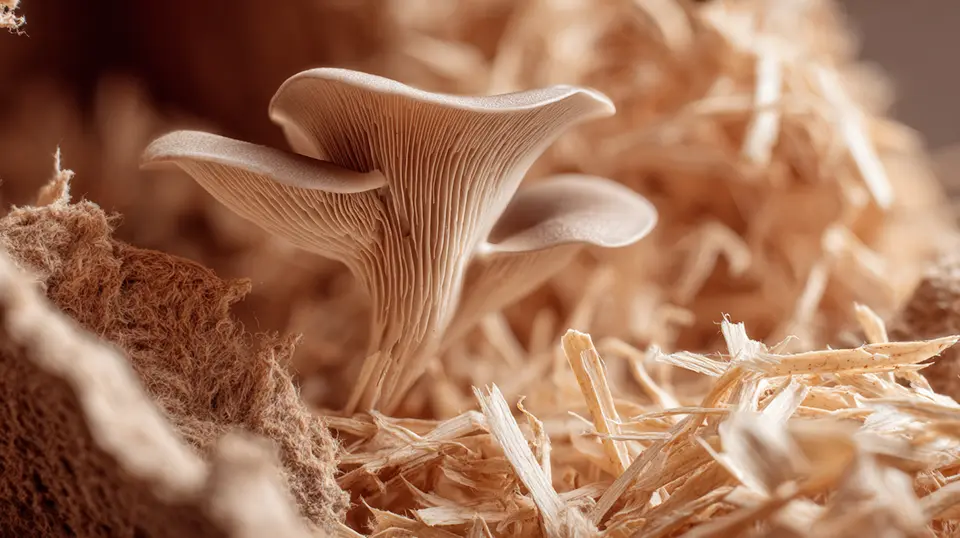
Plastic waste often piles up in landfills or leaks into oceans, harming wildlife and ecosystems. To address this, scientists at the Indian Institute of Technology Madras (IIT Madras) in Chennai allowed two well-known fungi — the oyster mushroom and the reishi mushroom — to grow on sawdust, coconut husk, hay, paper, and shredded cardboard.

Source: Wikimedia Commons, CC BY-SA 4.0
II. Mycelium as Natural Glue: How Fungi Build Foam-Like Materials
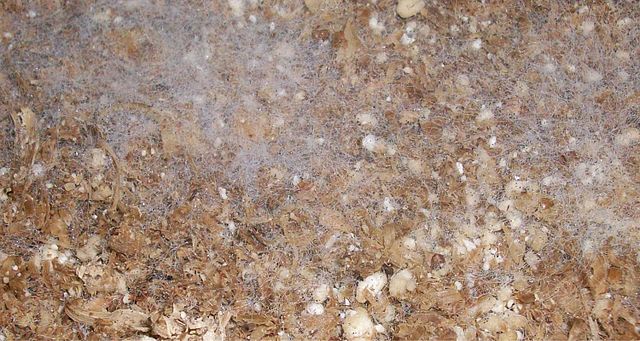
The fungal roots grew through these substrates, weaving them together like natural glue. After about two weeks, the roots completely colonized the material, forming a solid, lightweight, foam-like block that easily breaks down in soil.
After six weeks, some samples — particularly oyster mushroom grown on cardboard — lost up to 80% of their weight. The rest decomposed steadily, returning nutrients to the soil without leaving toxic residue.
Source: Wikimedia Commons, CC BY-SA 4.0
III. Strength, Water Resistance, and Compostability: A Viable Polystyrene Replacement
The reishi mushroom–cardboard composite was the strongest, while the oyster mushroom–sawdust composite also performed well. These composites repelled water, and some samples resisted moisture better than expanded polystyrene.
This means they could tolerate short-term moisture exposure, making them suitable for wrapping electronics or food items, the researchers note.

Source: Wikimedia Commons, CC BY-SA 4.0
References
- UN Environment Programme (UNEP). Plastic Waste Crisis.
- Indian Institute of Technology Madras. Research Division.
- Pleurotus ostreatus – Oyster Mushroom.
According to nature india