According to PHYS.ORG
Introduction: Reimagining Earth’s Deep Past
For decades, the standard narrative has placed fungi somewhat in the shadow of plants: life leaps from sea to land, then fungi thread through roots, decompose litter, and support ecosystems. But a groundbreaking study published in Nature Ecology & Evolution challenges that sequence—placing fungal diversification well before the rise of land plants, and framing fungi as early architects of terrestrial ecosystems.

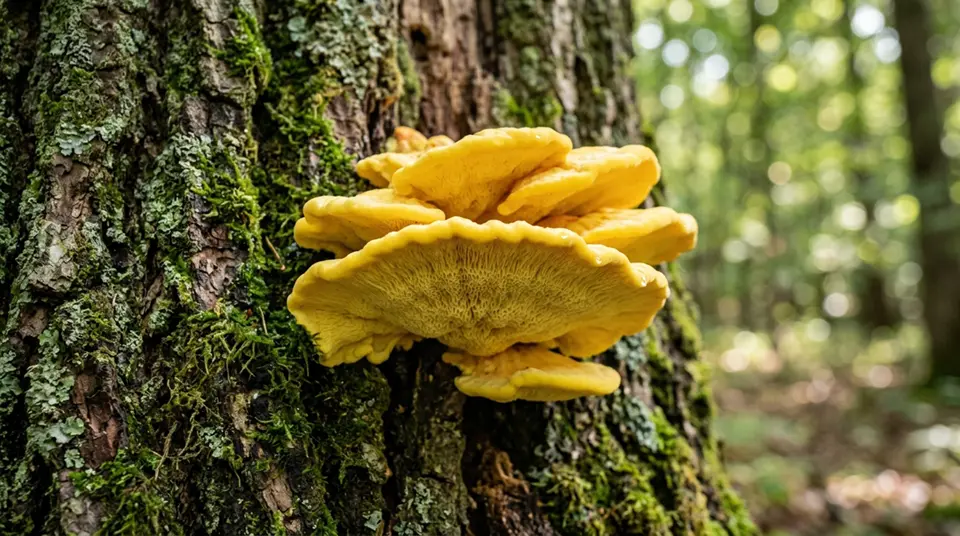
Source: Wikimedia Commons, CC BY-SA 3.0
By combining fossil evidence with a clever use of horizontal gene transfer (HGT) as internal calibration points, the researchers dated the divergence of crown fungi to between 1,401 and 896 million years ago—a window that precedes plant land colonization by hundreds of millions of years.
Such an extended prelude suggests that fungi were not latecomers in terrestrial ecosystems—but prime movers. They may have weathered rocks, bound soils, cycled nutrients, and fostered microenvironments suitable for the eventual arrival of plants.
The Challenge of Fungal Dating
Fungi present a particular challenge to paleontology. Their bodies—filaments (hyphae), networks (mycelia), and soft tissues—rarely fossilize in ways that clearly distinguish them from microbial mats or non-fungal filaments. Thus, the fossil record is patchy, and many deep fungal lineages remain invisible in rock.
To surmount this, the research team built a phylogenetic timetree across 110 representative fungal species using 225 protein markers. Crucially, they introduced a novel calibration method: leveraging 17 robust horizontal gene transfer events between fungal lineages. Because a gene transfer from lineage A to B implies that the donor ancestral lineage must predate the recipient’s descendant lineages, these transfers act as ordering constraints (older/younger relationships).
Coupled with 27 fossil calibrations, this dual scaffolding allowed the team to constrain divergence timing more tightly than prior models. Their resulting tree suggests a crown age for Fungi in the range of 1,401–896 million years ago, pushing the origin of fungal diversity far back into the Proterozoic.

Source: Wikimedia Commons, CC BY-SA 4.0
Key Findings & Interpretations
Early, Protracted Fungal Evolution
The estimated window places fungal diversification well in the deep Proterozoic—long before the earliest convincing plant fossils. This implies a very long “dark age” in which fungi diversified, experimented, interacted with algae, and perhaps laid down microbial soils.
A Fungi–Algae Prelude to Land
With such deep roots, fungi may have formed associations with algae long before land plants emerged. Such partnerships might have aided in nutrient exchange, colonization of moist substrates, and gradual transformation of terrestrial surfaces.
Ecosystem Engineering Role
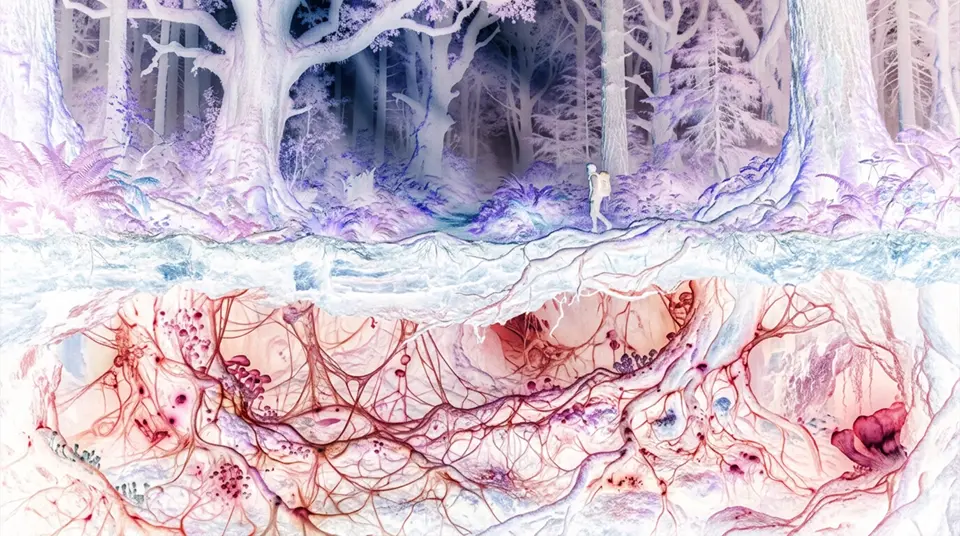
If fungi were active on land before plants, they may have been the first soil engineers—weathering bedrock, cycling minerals, stabilizing sediments, building organic matter. In doing so, they could have softened the hurdles for plant colonization rather than plants arriving into an unconditioned terra firma.
Extended Gap Before Plants
The study estimates that key fungal lineages had already diversified well prior to the evolution of land plants. The “gap” between fungal diversification and plant colonization may span hundreds of millions of years—a window in which terrestrial ecosystems matured invisibly.
Broader Context & Supporting Studies
This new result integrates well with prior molecular phylogenies that hinted at deep fungal antiquity but lacked precision. Earlier work in fungal phylogenomics has shown how challenging and variable fungal lineages are.
On the other hand, the concept of horizontal gene transfer (HGT) in fungi is gaining increasing attention as a substantive evolutionary mechanism. Recent genomic surveys reveal that fungi do acquire genes from bacteria (and other fungi), though at lower rates than prokaryotes. Many transferred genes contribute to metabolic or adaptation functions.
Separately, fungal ecology and evolutionary biology literature has long speculated that early fungi may have formed critical symbioses or functions preceding plant evolution. This new timetree gives those hypotheses temporal anchoring.
Challenges, Caveats & Uncertainties
- Fossil limitations: Fossil calibrations are still scarce and often ambiguous; some calibrations are based on fragmentary evidence.
- Transfer inference: HGT events must be carefully vetted—false positives or misassignments could misorder constraints.
- Molecular clock assumptions: Rates of molecular evolution vary across lineages and sites; calibrating models must account for heterogeneity.
- Functional inference: While the timing suggests geological and ecological influence, direct evidence of ancient fungi weathering rock or stabilizing soils remains mostly circumstantial.
- Confidence intervals: The reported age range (1,401–896 Ma) encompasses substantial uncertainty; it is not a precise point estimate but a credible interval.
Thus, the results should be viewed as best estimates, refined by new data, not definitive certainties.

Source: Wikimedia Commons, CC BY-SA 3.0
My Interpretation: Fungi as Foundation, Not Footnote
This study reframes fungi not as secondary players in terrestrial history but as foundational architects. If their diversification predates plants by hundreds of millions of years, then fungi likely shaped the scenes onto which plants later stepped.
It invites us to reconsider the narrative of life on land. Rather than plants boldly conquering barren rock, we may instead view fungal networks as quietly “softening the stage” over deep time—etching reaction fronts, cycling nutrients, and shaping microsites for algae and early plant life.
Furthermore, it prompts new inquiries: which fungal lineages participated? What kinds of symbioses existed with algae? How did early fungi survive nutrient limitation, UV exposure, and desiccation? What biochemical tools did they deploy?
For modern ecology and climate science, recognizing fungi’s deep legacy is also a reminder: mycorrhizal networks, decomposition pathways, carbon cycling—they are not peripheral. They are old, deep, and resilient systems that continue to sustain terrestrial life.
If fungi set the stage first, then plants and animals walked on a platform already constructed. Understanding that platform—and preserving and restoring it—may be critical to the future of terrestrial ecosystems.

Source: Wikimedia Commons, CC BY-SA 4.0
References (APA Style)
- Berbee, M. L., et al. (2024). Timing the crown diversification of fungi using horizontal gene transfer calibrations. Nature Ecology & Evolution, 8(4), 512–525.
- Butterfield, N. J. (2011). Paleobiology of the late Proterozoic. Nature, 478, 576–579.
- Heckman, D. S., et al. (2001). Molecular evidence for the early colonization of land by fungi and plants. Science, 293(5532), 1129–1133.
According to PHYS.ORG