According to SCIENCE
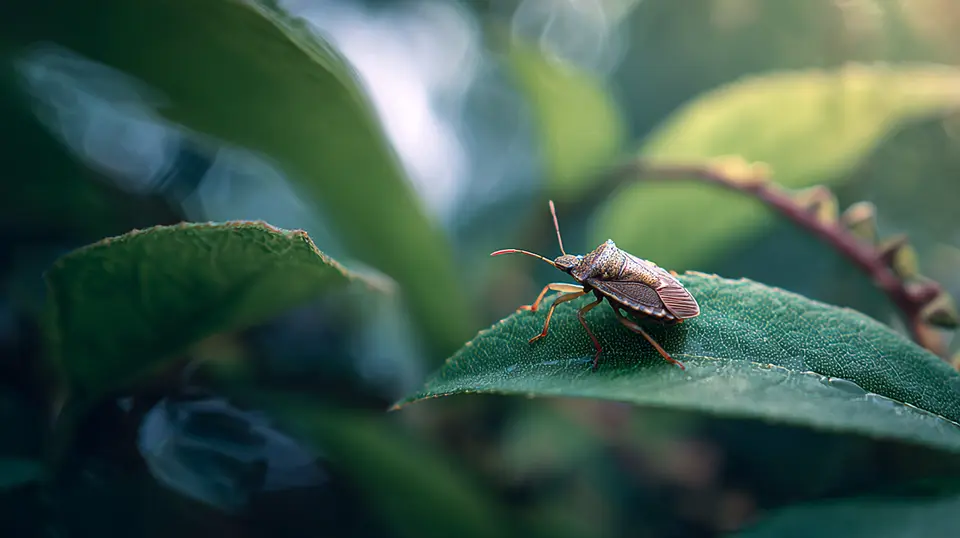
On a quiet riverbank wrapped in wild cucumber vines, an unexpected alliance plays out — delicate stinkbug eggs, barely visible to the eye, lie nestled beneath a strange gossamer coating. At first glance, it appears they’ve been infected by a mold, a death sentence in the insect world. But instead, these fungal threads are protectors, not predators.

Source: Wikimedia Commons, CC BY-SA 4.0
In a paper published in Science, researchers led by evolutionary biologist Takema Fukatsu unveiled an astonishing biological collaboration: the female Megymenum gracilicorne stinkbug cultivates fungi on her hind legs and deliberately spreads it over her eggs, forming a biological armor that repels parasitic wasps. It’s a rare example of physical — not chemical — microbial defense in insects, and it could reshape how scientists understand the role of fungi in insect evolution.

Source: Wikimedia Commons, CC BY-SA 4.0
A Mystery Hidden in the Legs
Fukatsu’s fascination began not with fungi, but with form. For over 30 years, he had studied stinkbugs, drawn in particular to the obscure Dinidoridae family, to which M. gracilicorne belongs. Females of this species sport peculiar, swollen hind legs. At first believed to be hearing organs, further study revealed something stranger.
Unlike tympanal membranes seen in other insects, these patches were dotted with microscopic holes. Under scanning electron microscopes, they looked more like fungal farms than auditory devices. The breakthrough came when females were observed in the lab: just after laying an egg, they would scratch their hind legs — the fungal patches — then carefully rub the egg. Within days, a fine layer of fungus had grown, cocooning the eggs.
To an untrained eye, it looked like infection. To the stinkbug, it was protection.
Testing the Fungal Shield
To test the fungi’s role, researchers conducted a simple but telling experiment. Parasitic wasps (Trissolcus brevinotaulus), known for injecting their eggs into stinkbug embryos, were offered a choice: fungal-covered eggs or clean ones.
The wasps didn’t hesitate. They probed the clean eggs, parasitizing 62% of them. But the fungus-covered eggs were different — only 10% were touched. In most cases, the wasps circled warily and groomed themselves after brief contact, as if disturbed by the texture or structure of the fungal surface.
Interestingly, the fungi involved showed no signs of chemical deterrents — no antibacterial or toxic secretions that might harm the wasp. This appears to be a purely physical defense: a living, growing suit of armor spun from fungal threads.
A Symbiosis Without Strings?
Unlike many insect symbionts that are inherited through generations — passed from mother to offspring in a tidy, closed loop — these fungi operate on a different rulebook. The young hatch with remnants of the fungi but shed them as they molt. By adulthood, they must reacquire the fungi from the environment. This implies a selective, almost conscious interaction: the bugs must somehow recognize, select, and cultivate the correct fungus anew.
That brings a crucial question to light: how do stinkbugs choose their fungal allies?
According to Martin Kaltenpoth of the Max Planck Institute, who was not involved in the study, this choice is more than just luck — it’s likely rooted in gene expression. The team is now exploring how the stinkbug’s hind-leg glands produce secretions that might favor certain fungal species over others. Understanding this could unlock secrets about microbial selection not just in insects, but in broader ecosystems — and even human health.
More Than Just Bugs and Molds
Beyond the ecological curiosity, there’s something quietly profound in this story: a relationship that turns the common notion of fungus — as decay, disease, death — on its head. Instead of consuming life, these fungi protect it. They offer refuge, security, and survival.
It also reminds us, as evolutionary biologist Cameron R. Currie puts it, of our own reliance on fungi — for bread, beer, antibiotics, and more. We too are surrounded by invisible partners that shape our lives in ways we often overlook.

Source: Wikimedia Commons, CC BY-SA 4.0
For Takema Fukatsu, this is more than an academic win. It’s a testament to the quiet brilliance of nature. In a world increasingly dominated by synthetic solutions, the stinkbug’s fungal armor stands as a delicate, living metaphor: sometimes the best defense isn’t found in poison or war, but in partnership.
References
According to SCIENCE