According to THE GUARDIAN
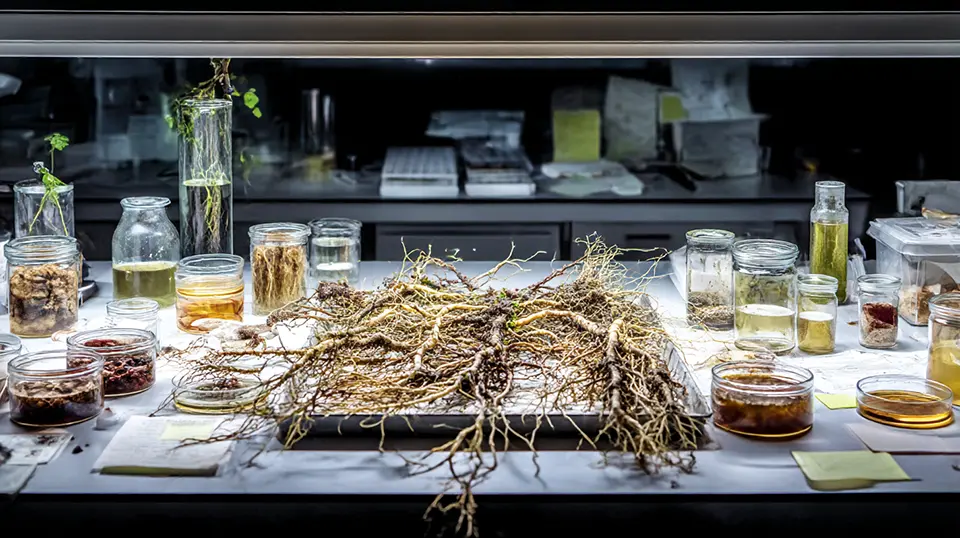
Inside a large greenhouse at the University of Kansas, rows of sudan grass grow in individual plastic pots under carefully controlled conditions. Beneath the soil surface, the roots of each plant host a distinct strain of arbuscular mycorrhizal fungi—microscopic organisms that play an outsized role in sustaining life on land. Nearby, shelves in a cold-storage room hold thousands of vials and sealed bags containing fungal spores, meticulously preserved and catalogued.

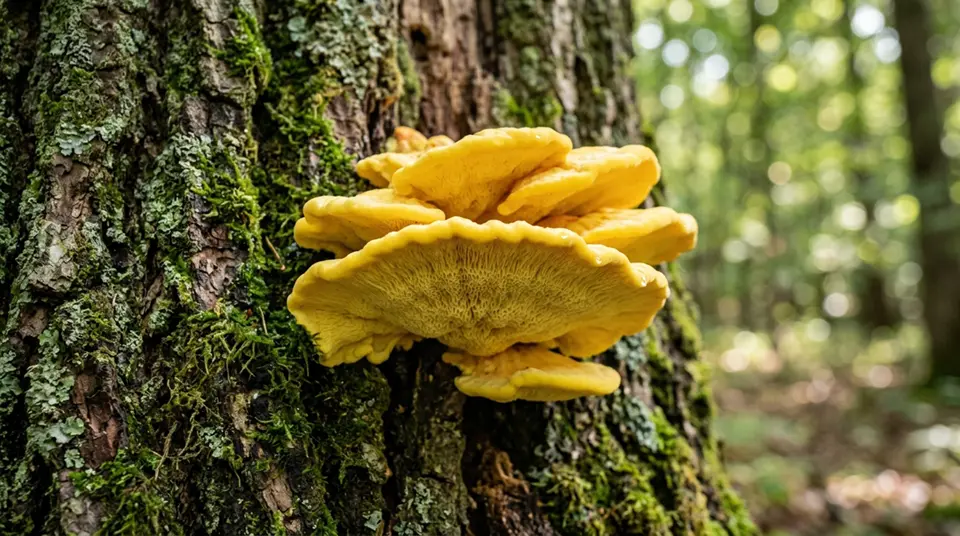
Source: Wikimedia Commons, CC BY-SA 4.0
Together, these materials form the International Collection of Vesicular Arbuscular Mycorrhizal Fungi (INVAM), the world’s largest living repository of arbuscular mycorrhizal fungi. Built over four decades, the collection contains living spores from more than 900 distinct fungal strains gathered from six continents. Now, due to the loss of federal funding, this globally significant scientific resource may be forced to close within a year.
Researchers warn that the potential loss of INVAM would have far-reaching consequences, not only for fungal science but also for ecosystem restoration, sustainable agriculture, and climate resilience.
A Living Library of Underground Ecosystems
Arbuscular mycorrhizal fungi are among the most ancient and widespread symbiotic organisms on Earth. They form intimate relationships with approximately 70 percent of land plant species, spanning forests, grasslands, croplands, and natural ecosystems. In exchange for sugars and lipids from plants, these fungi supply essential nutrients such as phosphorus, nitrogen, and trace metals, while also improving water uptake and buffering plants against drought, disease, and other stresses.
Unlike seed banks or frozen genetic repositories, INVAM is a living collection. The fungal strains it preserves must be actively maintained, propagated, and renewed each year. Without continuous care, the spores die. This makes the collection uniquely valuable—and uniquely vulnerable.
Scientists describe INVAM as a “living library” because each fungal strain represents millions of years of evolutionary adaptation. Collectively, the library preserves biological knowledge that cannot be reconstructed once lost.

Source: Wikimedia Commons, CC BY-SA 4.0
Unlike seed banks or frozen genetic repositories, INVAM is a living collection. The fungal strains it preserves must be actively maintained, propagated, and renewed each year. Without continuous care, the spores die. This makes the collection uniquely valuable—and uniquely vulnerable.
Scientists describe INVAM as a “living library” because each fungal strain represents millions of years of evolutionary adaptation. Collectively, the library preserves biological knowledge that cannot be reconstructed once lost.
The Threat of Defunding
INVAM was established in 1985 and has relied on continuous federal support since its inception. Its most recent funding from the National Science Foundation (NSF) ended in May 2025. While curators are preparing new grant proposals, the funding environment has become increasingly uncertain.
Why INVAM Cannot Simply Be Replaced
Maintaining arbuscular mycorrhizal fungi requires specialized expertise and labor-intensive processes that exist in very few laboratories worldwide. Unlike many fungi, these organisms do not grow independently on artificial media. They must be cultivated in association with living host plants.
At INVAM, technicians isolate spores from field soils under a microscope, identify them based on subtle morphological features, and manually inoculate them onto the roots of sterile seedlings. The plants are then grown in controlled greenhouse conditions for weeks, after which water stress is applied to stimulate spore production. Each strain must undergo this process annually to remain viable.
Researchers emphasize that this knowledge represents an “arcane skillset” built through decades of experience. Losing INVAM would mean losing not only the fungal strains themselves, but also the institutional expertise required to work with them.
Scientific and Practical Importance
The importance of arbuscular mycorrhizal fungi extends well beyond academic research. These fungi play a central role in:
- ecosystem restoration, helping degraded landscapes recover biodiversity and soil function
- soil health, improving aggregation, water retention, and nutrient cycling
- carbon storage, acting as a major underground sink for carbon dioxide
- sustainable agriculture, reducing dependence on synthetic fertilizers
Field experiments conducted with fungi sourced from INVAM have demonstrated dramatic ecological effects. In prairie restoration projects, soils inoculated with native mycorrhizal fungi supported greater plant diversity, faster establishment, and long-term ecosystem stability compared with control plots lacking fungal inoculation.
These results underscore why many ecologists view arbuscular mycorrhizal fungi as vital ecosystem engineers.
Modern Agriculture and Fungal Loss
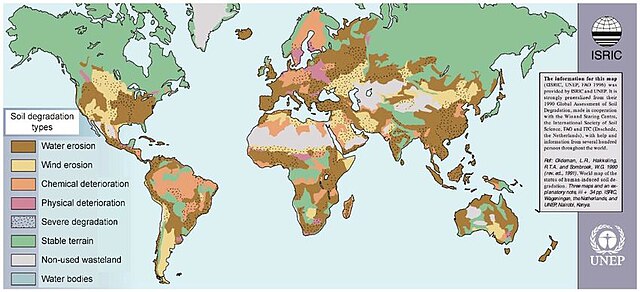
Despite their importance, arbuscular mycorrhizal fungi are often absent or severely depleted in intensively farmed soils. Practices such as deep tillage, excessive fertilizer application, and fungicide use disrupt fungal networks and reduce fungal diversity.
Studies show that in some long-cultivated soils, traces of arbuscular mycorrhizal fungi are barely detectable. Because these fungi disperse slowly and do not produce airborne spores, recolonization can take decades without human intervention.
This reality has driven interest in fungal inoculation as a tool for soil restoration and regenerative agriculture. However, researchers caution that the quality of commercial fungal products varies widely.
Source: Wikimedia Commons, CC BY-SA 4.0
The Biofertilizer Problem
INVAM also plays a critical role in evaluating and validating fungal biofertilizers. Independent studies have shown that a large proportion of commercial products marketed as mycorrhizal inoculants fail to colonize plant roots effectively. Some contain only dead spores, while others include unintended contaminants, including plant pathogens.
Despite these shortcomings, the global fungal biofertilizer market is valued at more than USD 1 billion annually. Researchers argue that the absence of strong regulation and the loss of public research infrastructure have allowed ineffective products to proliferate.
INVAM does not operate as a commercial producer. Instead, it provides verified, high-quality fungal material for research and restoration, serving as a benchmark for what functional mycorrhizal inocula should look like.
Climate Change and the Need for Fungal Diversity
As climate change alters rainfall patterns, temperature regimes, and soil conditions, the adaptive capacity stored within fungal diversity becomes increasingly important. Different arbuscular mycorrhizal strains confer different benefits to plants, from drought tolerance to nutrient efficiency.
Maintaining a broad library of fungal strains allows researchers to identify which symbioses are most effective under specific environmental stresses. The loss of such a library would limit the ability to respond to future ecological challenges.
Scientists emphasize that while plants can be reseeded and landscapes replanted, the loss of fungal diversity is far more difficult—often impossible—to reverse.

Source: Wikimedia Commons, CC BY-SA 4.0
Broader Implications for Public Science
The potential closure of INVAM highlights a broader issue facing publicly funded science: the vulnerability of long-term infrastructure to short-term budget decisions. Living collections, unlike individual research projects, require sustained investment to retain their value.
Researchers note that private donors may support targeted projects, but rarely provide the stable, multi-decade funding required to maintain foundational scientific resources. As a result, federally supported collections remain irreplaceable pillars of basic research.
The loss of INVAM would therefore represent not only a scientific setback, but also a structural weakening of global research capacity in fungal biology and soil ecology.
What Is at Stake
If INVAM closes, hundreds of unique fungal strains may be lost permanently. Along with them would disappear opportunities to:
- restore degraded ecosystems more effectively
- reduce fertilizer use and agricultural pollution
- improve climate resilience in crops and natural systems
- answer fundamental biological questions about fungal evolution and symbiosis
Scientists stress that arbuscular mycorrhizal fungi remain poorly understood, and many of their most intriguing biological traits—such as their unusual cellular organization and ability to form hybrids—can only be studied using living cultures.
References
INVAM – International Collection of Vesicular Arbuscular Mycorrhizal Fungi
FAO – Mycorrhizal Fungi and Soil Biodiversity
NSF – Budget and Funding Overview
According to THE GUARDIAN