According to MSN
A Noise That Changed Everything
It was the kind of noise that could wrench anyone from the deepest sleep—a sharp crack, followed by a deafening crash. At 4:30am on Monday morning, Amber James, 25, woke to that sound in her Hollingbury, Brighton council flat. Her first thought wasn’t about the noise or the property—it was about her children.
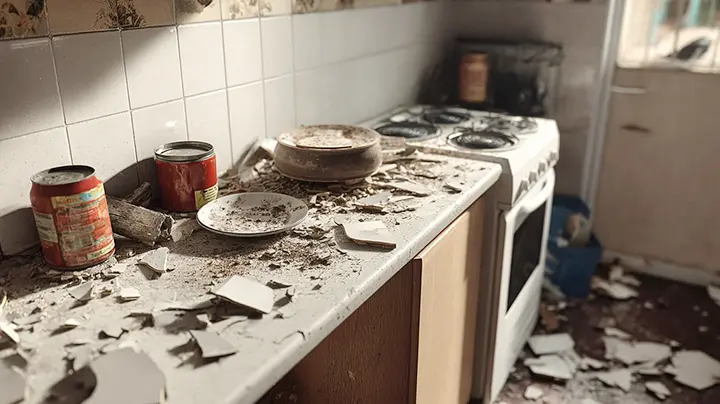
Racing into her four-year-old son’s bedroom, she found him still asleep, safe under the covers, oblivious to the chaos unfolding just metres away. In the kitchen, the scene was a different story: the ceiling had given way, leaving a jagged hole that exposed rafters above, with chunks of plaster, wood, and dust strewn across the sink and cooker.
Amber stood in shock. “I started crying at the thought of what could have happened if me or my sons were in the kitchen when this happened,” she said later, her voice still carrying the disbelief of that early morning moment.

Source: Wikimedia Commons, CC BY-SA 2.0
From Damp to Disaster
The collapse was the culmination of a mould and damp problem that Amber says was first formally reported in mid-May. According to her, Brighton & Hove City Council contractors did visit on June 17, but their approach was cosmetic rather than structural. “They just washed and painted over the mould,” she said.
By June 30, the black mould (Stachybotrys chartarum) was back, re-emerging through the fresh coat of paint like a silent defiance. Amber reported it again. A week later, a supervisor inspected the property and allegedly told her the damp and mould were “safe.”
Her frustration is palpable: “I’m so disgusted by the council allowing it to get this far after I’ve reported it multiple times.”

Source: Wikimedia Commons, CC BY-SA 3.0
A Known Health Risk
The mould in Amber’s kitchen was more than an eyesore. Judging from her description and photographs, it’s likely to have included black mould—a fungus known for thriving in water-damaged environments and producing airborne spores that can irritate the respiratory system.
For Amber, the health implications weren’t hypothetical. Her four-year-old son has been prescribed an asthma pump, and she suspects the damp living environment may have played a role in his ongoing health struggles. “You worry about the ceiling, yes,” she said, “but I’ve been worried about the air we’ve been breathing for months.”
No Place to Call Home
The ceiling collapse left Amber’s kitchen unusable and her home unsafe. With no immediate rehousing offer from the council, she and her two children—ages four and one—moved temporarily into her mother’s home. The arrangement is far from ideal: the three of them are sharing a single double bed in her sister’s room while her sister is away.
“I’ve had no contact from the council regarding where I’m supposed to stay,” Amber said, noting that she is still “trying to get answers” from housing officials. The uncertainty is gnawing at her, even as she tries to focus on her children’s comfort and safety.
Council Accountability in Question
Brighton and Hove Council have yet to provide a public response to Amber’s account. But this incident is likely to raise broader questions about how local authorities handle tenant reports of damp and mould—particularly when the tenants are families with young children.
Housing campaigners have long warned that painting over mould without addressing underlying leaks or ventilation issues is not only ineffective but dangerous. “It’s not just about appearance; mould can be a serious public health risk,” said one local housing advocate. “Councils have a legal duty to ensure properties are safe to live in. This clearly wasn’t the case here.”
Mould and Negligence: A Wider Problem
Amber’s case is far from isolated. Across the UK, mould-related hazards have been thrust into the public spotlight following tragic cases like that of two-year-old Awaab Ishak, who died in 2020 from a respiratory condition linked to prolonged exposure to mould in his family’s council flat. That case led to calls for stricter enforcement of housing standards and prompted the government to draft “Awaab’s Law”, mandating quicker action from landlords when hazards are reported.
Yet on the ground, delays and inadequate repairs persist. The gap between policy and practice often leaves vulnerable tenants exposed for months or even years to conditions that compromise their health.
The Science Behind the Collapse
Mould growth and damp damage can significantly weaken building materials over time. Black mould thrives in cellulose-rich materials like plaster, drywall, and wood when moisture is present. As it grows, it can contribute to the gradual breakdown of these materials’ structural integrity.
When left untreated—or treated superficially—the combination of fungal growth, moisture infiltration, and temperature fluctuations can cause ceilings to sag, crack, and eventually collapse.
In Amber’s kitchen, the problem likely began with a persistent leak or poor ventilation, creating the ideal environment for both mould growth and timber decay. Without removing the source of moisture and replacing compromised materials, any repair was doomed to fail.

Source: Wikimedia Commons, CC BY-SA 4.0
Health First: Lessons from the Case
The incident underscores the urgent need for councils to treat mould and damp as health hazards rather than minor maintenance issues. While mould spores can affect anyone, children, the elderly, and people with pre-existing respiratory conditions are particularly vulnerable. Symptoms can range from coughing and wheezing to skin irritation and, in severe cases, lung infections.
Medical experts also warn that prolonged exposure to black mould toxins can exacerbate asthma and other chronic illnesses. In some cases, recovery requires not just medical treatment but removal from the contaminated environment.
The Emotional Toll
Beyond the physical damage and health concerns, the collapse has taken a deep emotional toll on Amber. “It’s hard to sleep now,” she admitted. “Every sound makes me wonder if something else is going to break. You’re supposed to feel safe in your own home, but I haven’t felt that in a long time.”
Her children, too young to fully understand the situation, are adjusting to living in a crowded room at their grandmother’s house. Amber tries to keep routines intact, cooking in a shared kitchen, managing bedtimes, and keeping toys and school supplies organised in a much smaller space. But the uncertainty about when—or if—they can return home weighs heavily on her.
A Call for Change
Amber’s story should serve as a wake-up call to local authorities everywhere. Damp and mould are not minor nuisances to be hidden under fresh paint; they are warning signs of deeper structural and environmental issues that can escalate into life-threatening situations.
Housing experts argue that councils must adopt a “root cause” approach, tackling leaks, ventilation problems, and insulation failures directly, rather than applying cosmetic fixes. Furthermore, they say, tenants should have access to clear timelines and transparent reporting processes to ensure accountability.
What Comes Next
As Amber waits for the council’s next move, she is determined to keep pushing for answers and accountability. “I don’t want anyone else to go through this,” she said. “We were lucky this time. But luck isn’t a housing policy.”
Her experience is a reminder that behind every headline about mould or damp is a family whose home—and often health—has been compromised. Until councils treat these hazards with the seriousness they deserve, more families will face the same fear Amber felt at 4:30am when her ceiling came crashing down.
References
Brighton & Hove City Council. Housing services.
According to MSN