According to ASTROBIOLOGY
1. Introduction – Life at the Edge of Possibility
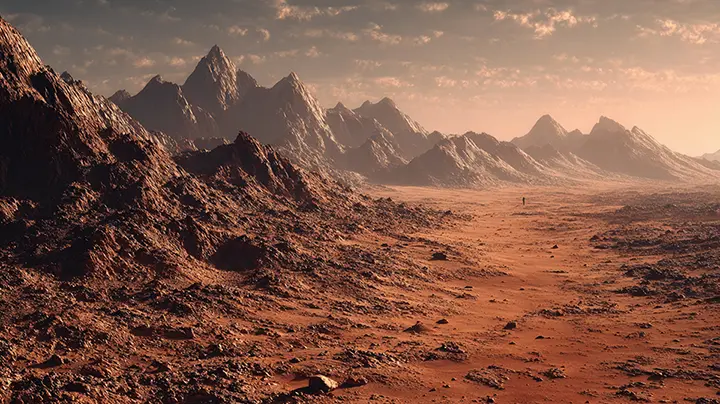
Mars has long been seen as a barren, hostile world. Its thin atmosphere, intense ultraviolet radiation, toxic salts, and lack of liquid water make its surface an extraordinarily difficult place for life to endure. Yet scientists continue to test whether any Earth organisms can tolerate such punishing conditions. A recent study has revealed that a black fungus, Rhinocladiella similis, is capable of surviving Mars-like extremes. This discovery is reshaping scientific thought about where and how life can exist.
Source: npj Microgravity / Nature Portfolio, PubMed record.
The research demonstrates that terrestrial fungi may provide models for potential life strategies on Mars. By enduring simulated Martian soil chemistry and radiation exposure, R. similis shows that adaptability and resilience in microorganisms may extend much further than once imagined.
Source: npj Microgravity / Nature Portfolio.

Source: Wikimedia Commons (NASA PD), Public Domain.
2. The Fungus Behind the Findings
Rhinocladiella similis belongs to a group of black fungi known for their resistance to acidic environments and chemical stress. These fungi are characterized by their dark pigmentation, which provides a protective barrier against radiation. Researchers exposed R. similis to a series of controlled experiments simulating Martian surface conditions.
Source: ACS Au (overview on black yeasts), npj Microgravity / Nature Portfolio
The challenges included:
High concentrations of magnesium perchlorate, a toxic salt detected on Mars.
Intense ultraviolet C (UV-C) radiation, which is highly damaging to DNA.
Extended desiccation, mimicking the dryness of the Martian atmosphere.
Despite these extremes, R. similis survived. It maintained strong growth, exhibited adaptive changes in morphology, and sustained viability even when exposed to radiation levels that would kill many other microbes.
Source: npj Microgravity / Nature Portfolio, KAUST press summary via Astrobiology.com.

(Bottom) A tube which emits short wave UV-C radiation, used for germicidal lamps. It contains mercury vapor which radiates UV at 253 nm. The envelope is made of quartz, which is transparent to UV-C.
Source: Wikimedia Commons, CC BY-SA 2.5.
3. Why the Discovery Matters
Understanding how fungi respond to Mars-like environments helps astrobiologists assess the potential for life beyond Earth. This study provides evidence that eukaryotic life—organisms with complex cellular structures—can survive in conditions once thought entirely lethal.
Source: npj Microgravity / Nature Portfolio.
Key implications include:
Guiding Mars exploration: Knowing which types of organisms endure perchlorate and UV radiation informs where missions should search for biosignatures.
Refining life-detection instruments: Insights into fungal survival strategies can shape the design of tools used on rovers and landers.
Expanding definitions of habitability: If fungi can adapt to Martian stressors, other extremophiles may also thrive in hidden niches.
This discovery does not prove that life exists on Mars, but it demonstrates that life’s survival toolkit is broader than expected.
Source: npj Microgravity / Nature Portfolio, Cryomyces & space exposure studies.

Source: Wikimedia Commons (NASA PD), Public Domain.
4. A Critical Perspective
While the results are groundbreaking, caution is necessary. Laboratory simulations cannot fully replicate Martian complexity. On Mars, organisms would face fluctuating temperatures, dust storms, atmospheric pressure changes, and constant cosmic radiation. Survival in controlled settings does not guarantee long-term persistence on the Martian surface.
Source: Cryomyces Antarcticus space/Mars-sim exposure, Onofri et al., survival in simulated Martian conditions.
Another consideration is planetary protection. Earth organisms must not be inadvertently introduced to Mars, where they could contaminate environments and compromise the search for indigenous life. Studies like this highlight the importance of strict biosafety protocols when designing future space missions.
Source: COSPAR Planetary Protection Policy (PDF), NASA Planetary Protection (OSMA).
5. Extremophiles in Context
The resilience of R. similis adds to a growing list of extremophiles that astonish scientists:
Cryomyces species have survived extended exposure to space radiation and vacuum conditions.
Deinococcus radiodurans, often called the world’s toughest bacterium, is able to repair its DNA after intense radiation damage.
Chroococcidiopsis, a cyanobacterium, endures desiccation and high radiation, making it another Mars candidate for survival.
Source: Cryomyces studies, [D. radiodurans reviews](https://pmc.ncbi.nlm.nih.gov/articles/PMC3063356/; https://pmc.ncbi.nlm.nih.gov/articles/PMC6300522/), [Chroococcidiopsis research](https://pmc.ncbi.nlm.nih.gov/articles/PMC9769825/; https://pubmed.ncbi.nlm.nih.gov/15815164/; https://www.liebertpub.com/doi/10.1089/ast.2018.1900).

Source: Wikimedia Commons (US DOE PD), Public Domain.

Source: Wikimedia Commons, CC BY-SA 4.0.
6. Personal View – Hope with Responsibility
As inspiring as this research is, it must be approached with balanced optimism. The discovery of fungi thriving under Mars-like conditions underscores the resilience of life, yet it also raises profound questions about how humanity should explore other worlds.
Source: COSPAR PP Editorial (2024 update, PDF).
My perspective is that such results should encourage continued research into extremophiles, but they must also remind us of our responsibility to preserve extraterrestrial environments. We are not simply asking whether life can survive on Mars; we are asking how we, as explorers, ensure that our search for life is not compromised by accidental contamination.
Source: NASA Planetary Protection – Crewed Mars brief (PDF), National Academies – Planetary Protection Considerations.
7. Next Steps in Research
Future investigations could deepen our understanding by:
Conducting long-term simulations that combine multiple Martian stressors, including temperature cycles and atmospheric pressure changes.
Sequencing fungal genomes under stress to identify survival pathways.
Comparing R. similis with other black fungi to uncover shared adaptations.
Testing biosignature molecules released during stress responses to refine detection methods for space missions.
Source: npj Microgravity / Nature Portfolio, ProteomeXchange dataset PXD050600.
Such directions will not only help astrobiology but may also inspire biotechnological applications on Earth. Fungi capable of resisting radiation and chemical toxicity could provide insights into medicine, environmental clean-up, and sustainable technologies.
8. Broader Implications
This study reminds us that habitability is not a fixed concept. Mars, long considered sterile, may host micro-niches where organisms could endure. For instance, brine flows beneath the surface, protected from radiation, could provide refuge for life forms adapted to perchlorates.
Source: Nature Coverage / npj Microgravity paper. Nature
Even if life never originated on Mars, Earth organisms demonstrate that survival in such conditions is possible. This has profound implications for exoplanetary science. If fungi and microbes can tolerate Mars-like environments, then planets orbiting other stars—once dismissed as uninhabitable—might also host resilient forms of life.
Source: [Cryomyces & Chroococcidiopsis survival literature](https://pmc.ncbi.nlm.nih.gov/articles/PMC5650992/; https://pmc.ncbi.nlm.nih.gov/articles/PMC9769825/).
9. Conclusion – Life Finds a Way
The endurance of Rhinocladiella similis under Mars-like extremes challenges assumptions about the fragility of life. It demonstrates that fungi, with their remarkable adaptability, may hold keys to understanding not only survival on Earth but also the possibilities of life elsewhere in the universe.
Source: npj Microgravity / Nature Portfolio, PubMed record.
While caution is necessary to avoid overstating the findings, the message is clear: life is tougher than we thought, and the boundaries of habitability are wider than imagined. Humanity’s exploration of Mars, and beyond, must therefore continue with curiosity, rigor, and responsibility.
Source: COSPAR Planetary Protection Policy (PDF), NASA Planetary Protection (OSMA).
According to ASTROBIOLOGY